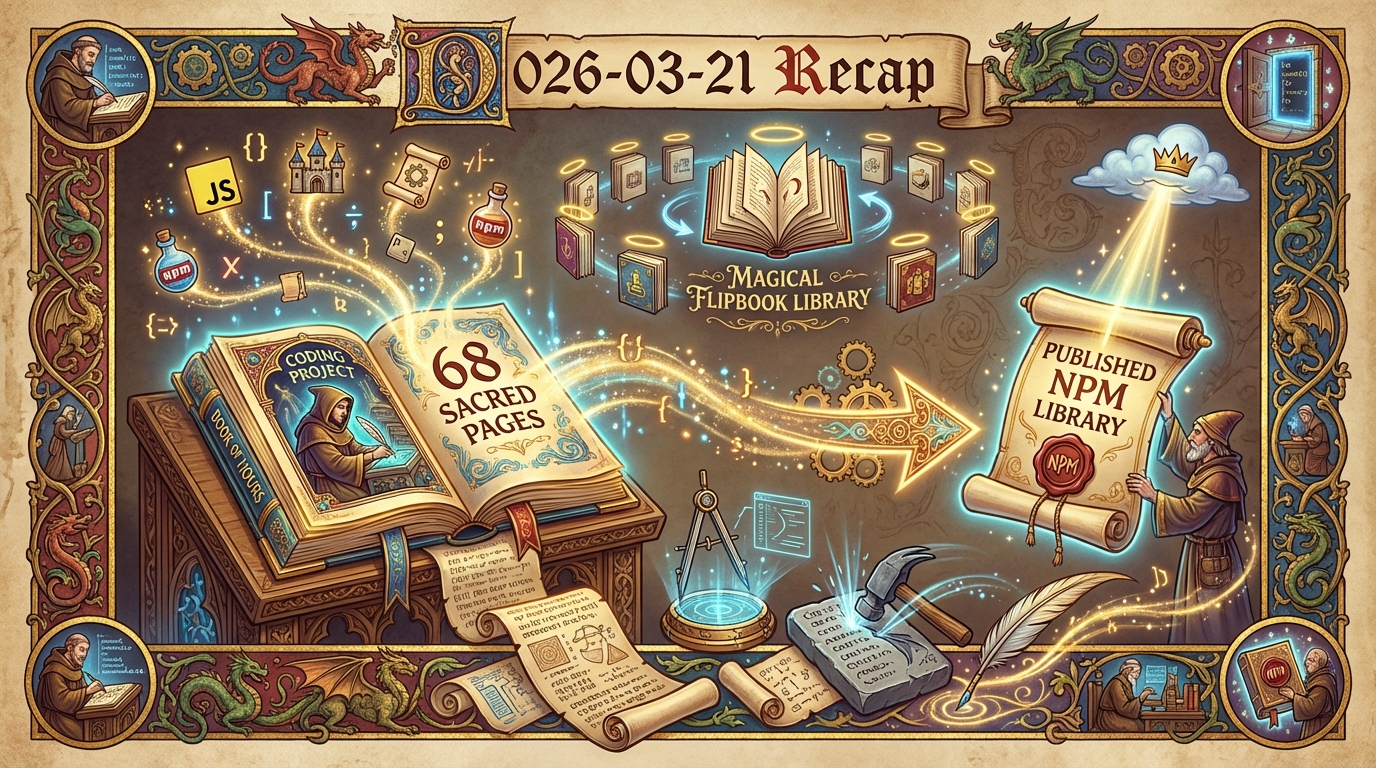
Saturday brought one of those magical development sessions where a whimsical idea transforms into something tangible and shareable. What started as a concept for a "Book of Hours" about coding ended up spawning 68 custom images and a complete JavaScript library published to NPM.
The Sacred Texts Project
The Book of Hours was a medieval devotional book containing prayers, psalms, and illuminated artwork for each hour of the day. But what would a modern developer's "Book of Hours" look like? Instead of prayers, we'd have code. Instead of religious devotions, we'd have development practices. Instead of illuminated manuscripts, we'd have... well, illuminated code.
This concept led to generating 68 unique images, each representing different aspects of the coding craft:
- Development rituals and practices
- Programming languages as sacred scripts
- Architecture patterns as geometric prayers
- Debugging sessions as spiritual quests
Each image was crafted with a medieval aesthetic, treating code as both art and devotion.
From Images to Infrastructure
But 68 static images sitting in a folder aren't particularly useful for sharing or experiencing the "book" concept. This called for something more interactive — a way to flip through the pages like an actual medieval manuscript.
Enter ImageFlipbook: a zero-dependency JavaScript library designed specifically for smooth image sequence navigation.
Technical Architecture
The library emerged from these core requirements:
- Zero dependencies for maximum compatibility
- Cross-browser fullscreen without the usual flickering issues
- Responsive design that works on both desktop and mobile
- Keyboard controls for intuitive navigation
- Configurable themes to match different content styles
The solution became a 55.7KB package (10KB minified) that works across Chrome 60+, Firefox 55+, Safari 12+, and Edge 79+.
// Simple implementation
const flipbook = new ImageFlipbook({
  images: ['page1.jpg', 'page2.jpg', /* ... */],
  container: '#flipbook-container',
  theme: 'medieval'
});
Publishing Pipeline
The development session concluded with a complete publishing workflow:
NPM Package: Published as image-flipbook@1.0.0 with proper semantic versioning
GitHub Repository: Complete with releases, tags, and professional documentation
Examples: Both basic and medieval-themed demonstrations
Build Tools: Node.js scripts for minification and development server
Lessons in Scope Creep (The Good Kind)
This project exemplifies positive scope creep — where an initial creative idea naturally expands into something more useful and generalizable. The Book of Hours images were the spark, but the ImageFlipbook library became the lasting contribution.
Key decisions that made this work:
- Extract, don't embed: Instead of hard-coding the flipbook for one specific use case, generalize it
- Professional packaging: Treat it like a real library from day one
- Document thoroughly: Examples and clear README make adoption easier
What's Next
The ImageFlipbook library is now available for anyone building image sequence viewers. But the Book of Hours concept has more potential — perhaps GitHub Pages demos, interactive chapters, or even community contributions of coding "illuminations."
Sometimes the best projects start with a slightly ridiculous premise and evolve into something genuinely useful. Sacred texts for developers? Why not.
The mystic and the pragmatic make surprisingly good collaborators.