Thinking out loud about a VirusMon video
Stepped back from code today to figure out how to actually talk about VirusMon on YouTube without falling into the generic 'building with AI' trap.
lab-journalvirusmon
Dev logs, build notes, and experiments. What got shipped, what broke, and what I learned along the way.
Stepped back from code today to figure out how to actually talk about VirusMon on YouTube without falling into the generic 'building with AI' trap.
Spent Sunday digging through old screenshots and devlog entries to figure out the actual story worth telling about VirusMon.
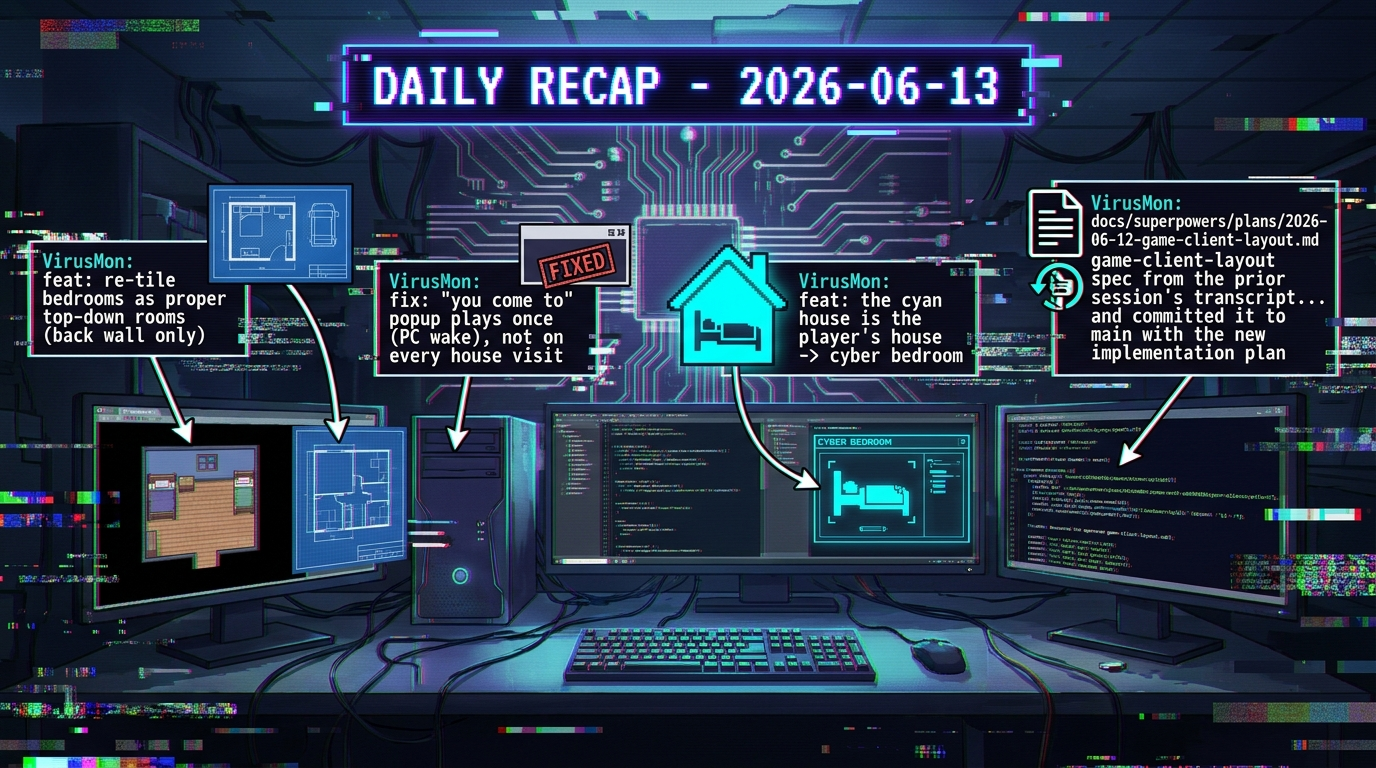
A big content day on VirusMon — story intro sequence, route-2 rebuilt twice, and a Viridian-style northern town wired up.
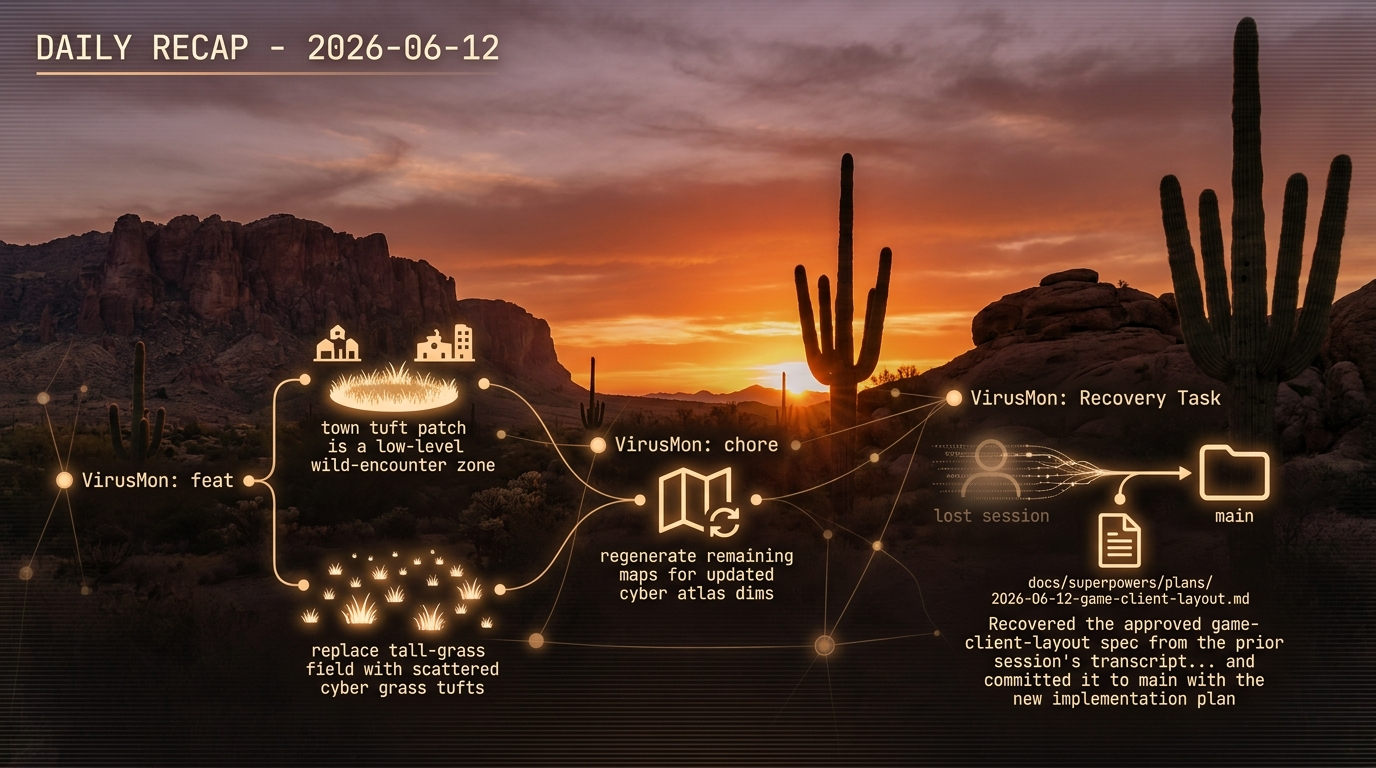
A long day pulling the cyber town art into the actual game, fixing a font fiasco, and turning the lower-left tuft patch into a starter encounter zone.
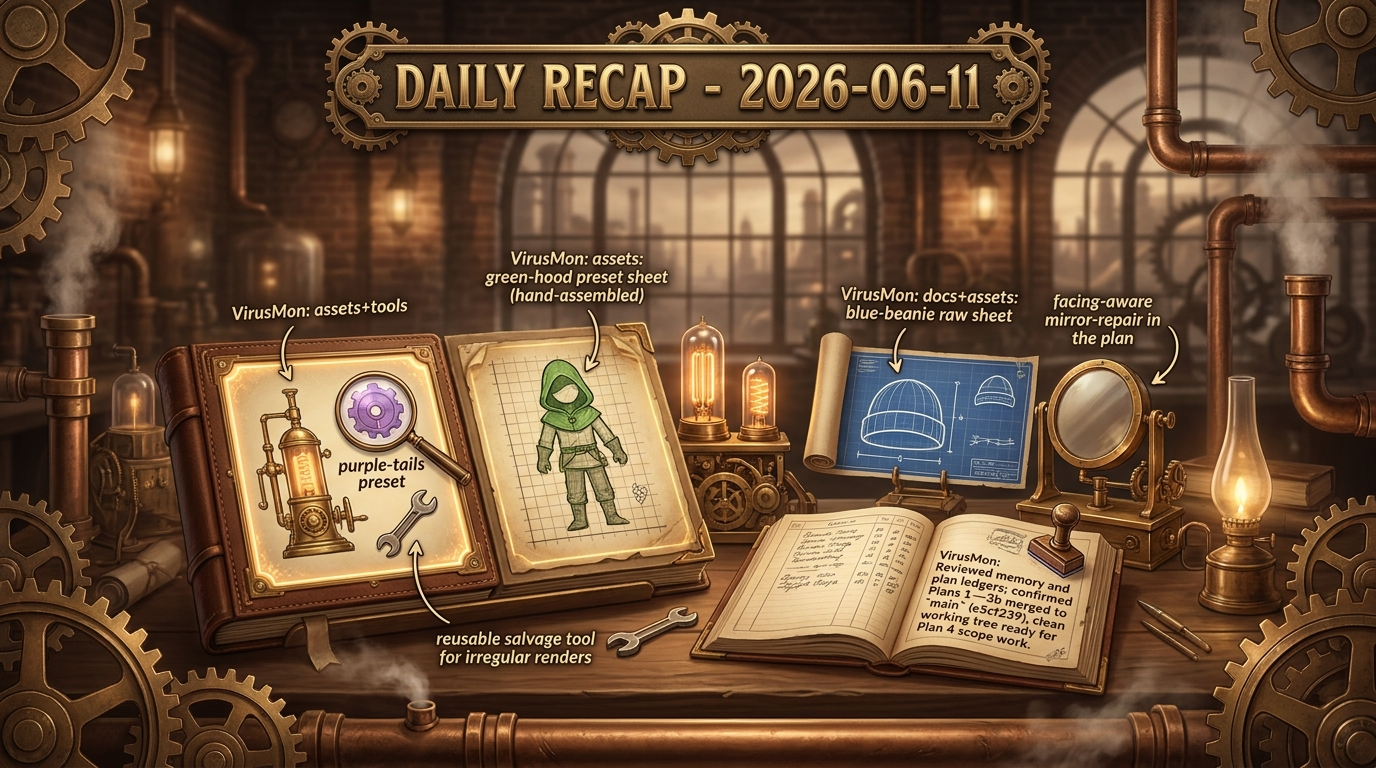
One of those days where four plans land back-to-back and VirusMon finally starts to feel like a game.
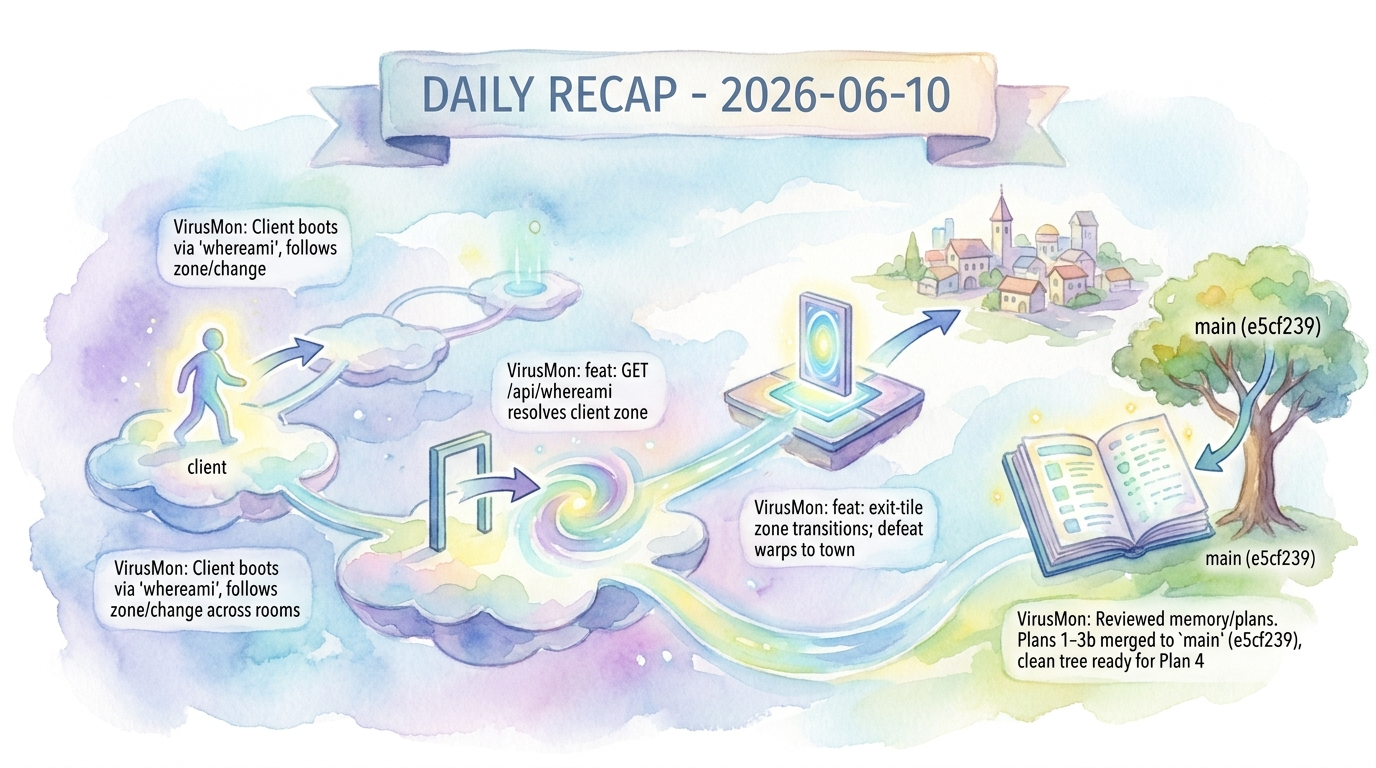
Walking skeleton, battle engine, persistence, catching, and zone transitions — VirusMon went from scaffold to genuinely playable in one long sitting.
Spent the day turning a pile of brainstorming notes into an approved design document for a hacker-con Pokémon game.
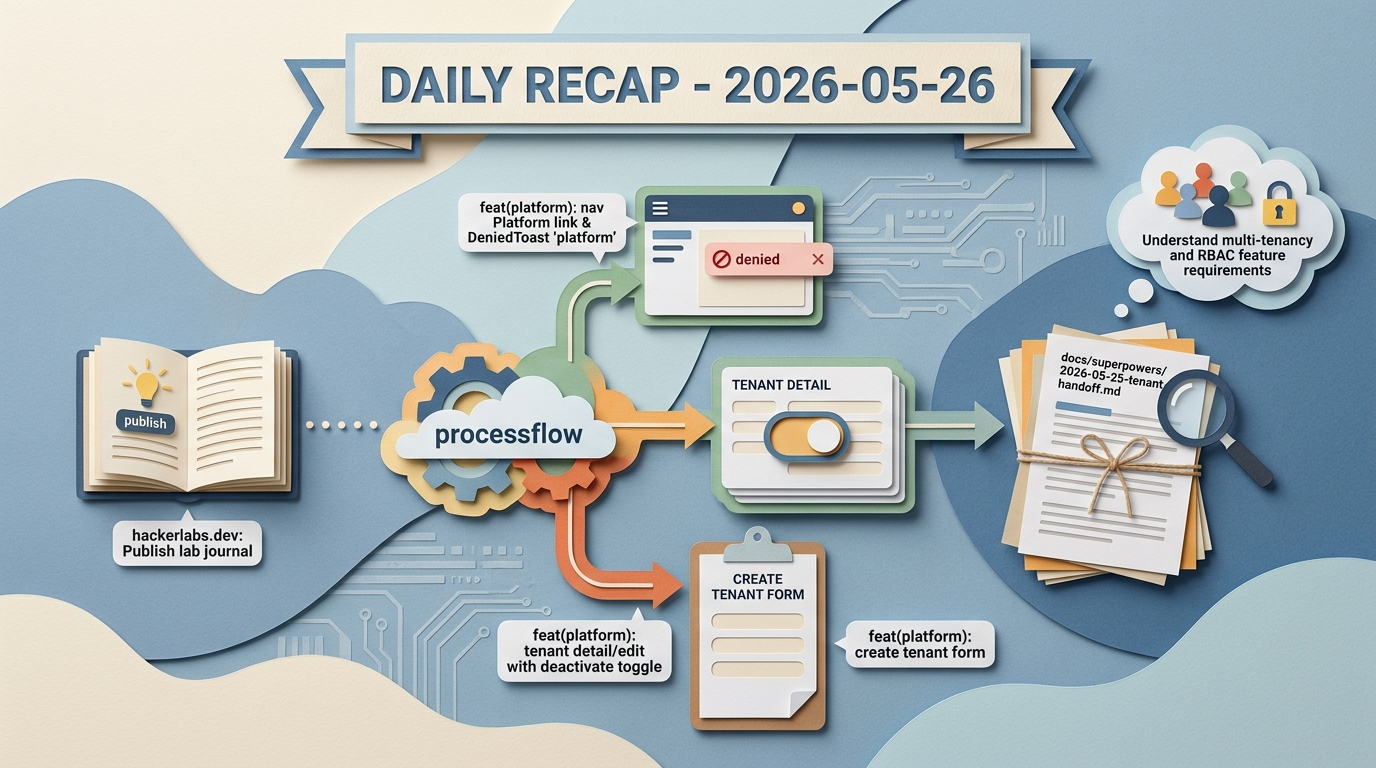
After yesterday's graph engine marathon, today was about giving processflow a proper platform admin role — tenant CRUD, deactivation, navigation gating, and the security tests to back it all up.
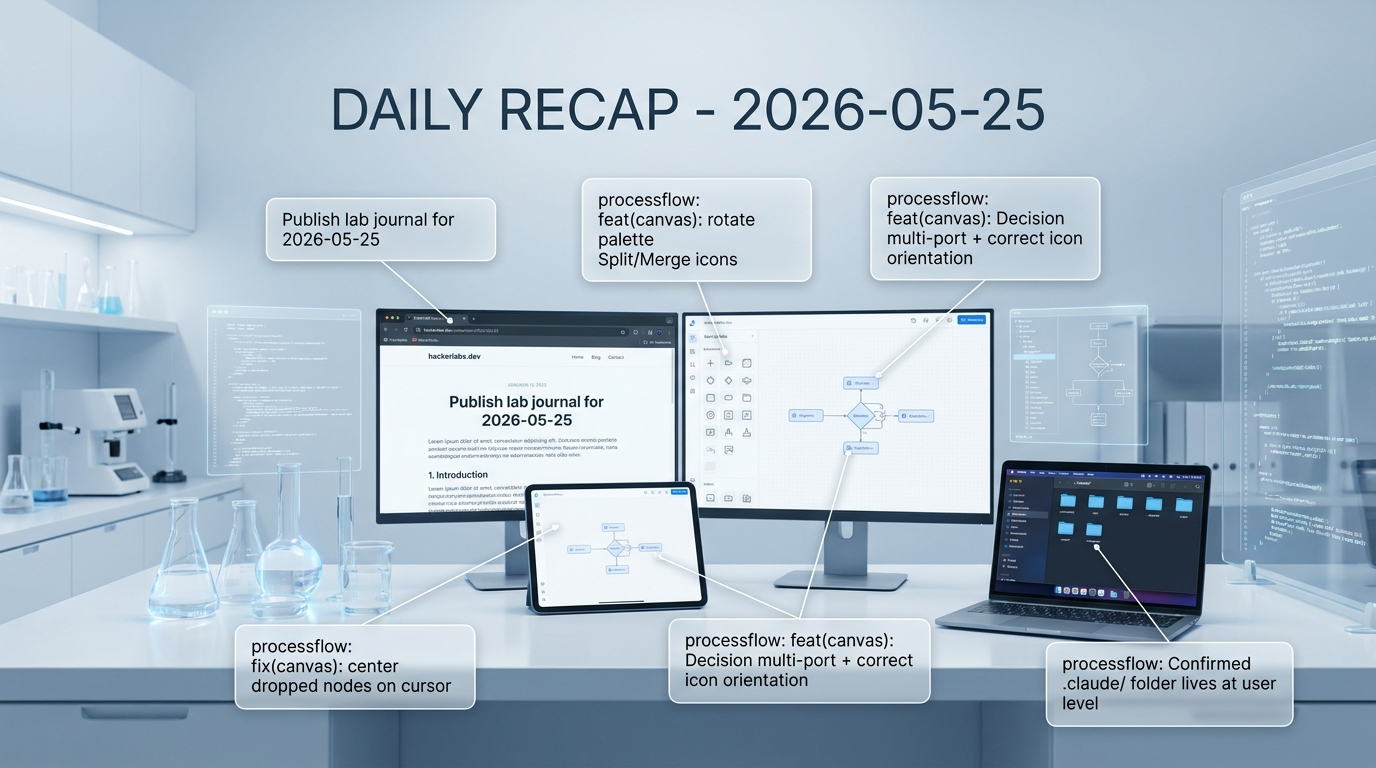
A holiday Monday turned into the biggest processflow push in months: full canvas-based template builder, a new graph execution engine, role-based access, and end-to-end tenant scoping.
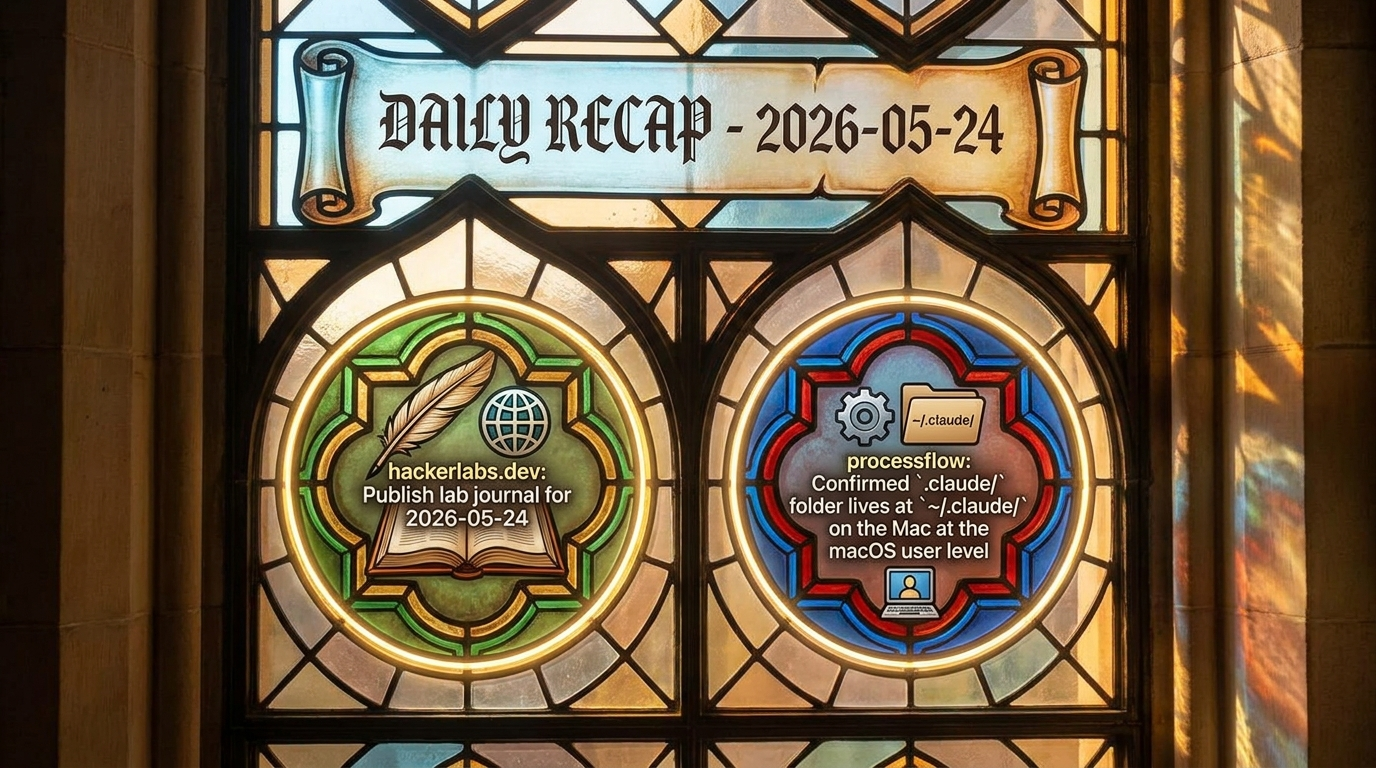
Mostly a paperwork day, but I confirmed something I'd been curious about: Claude Code's project memory is tied to the Mac user, not the Claude.ai login.
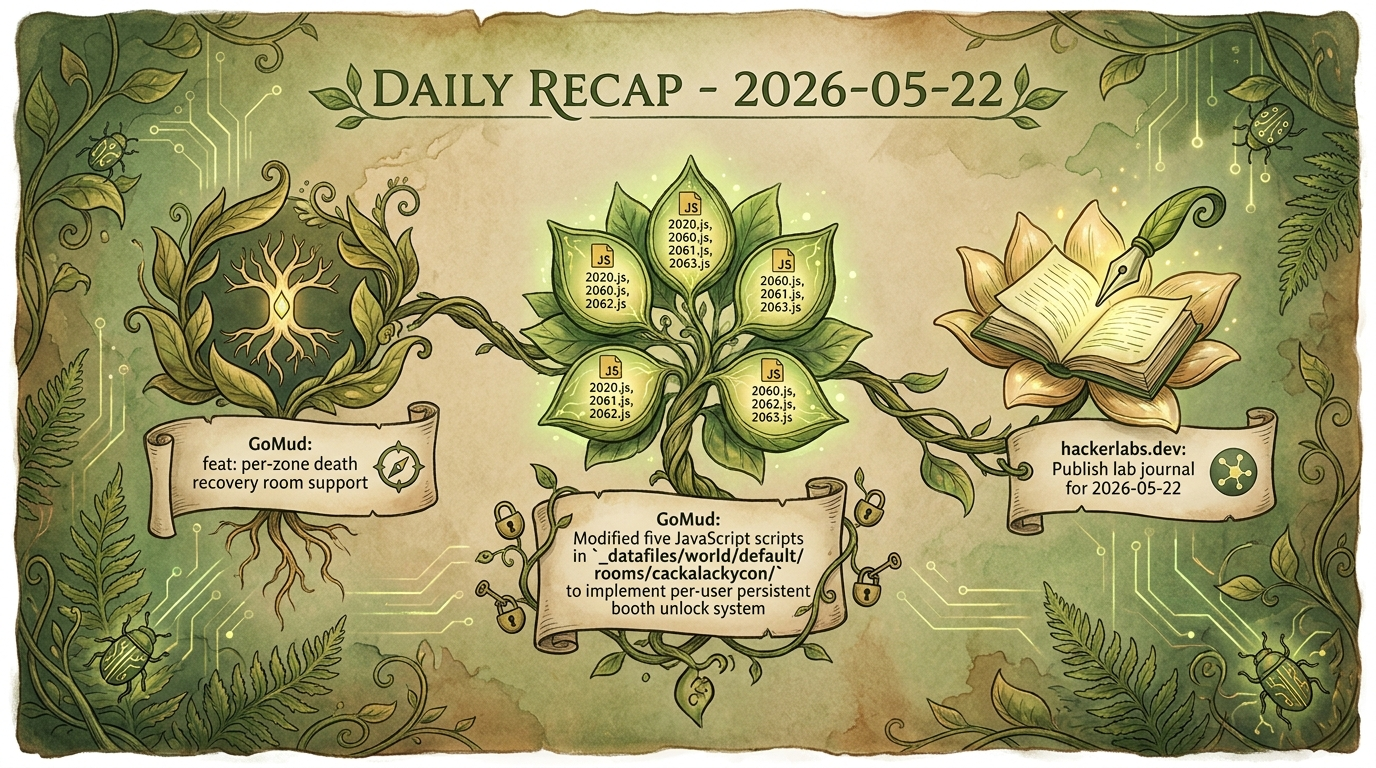
GoMud gets zone-scoped respawn rooms and a per-user persistent booth lock system for the cackalackycon area.
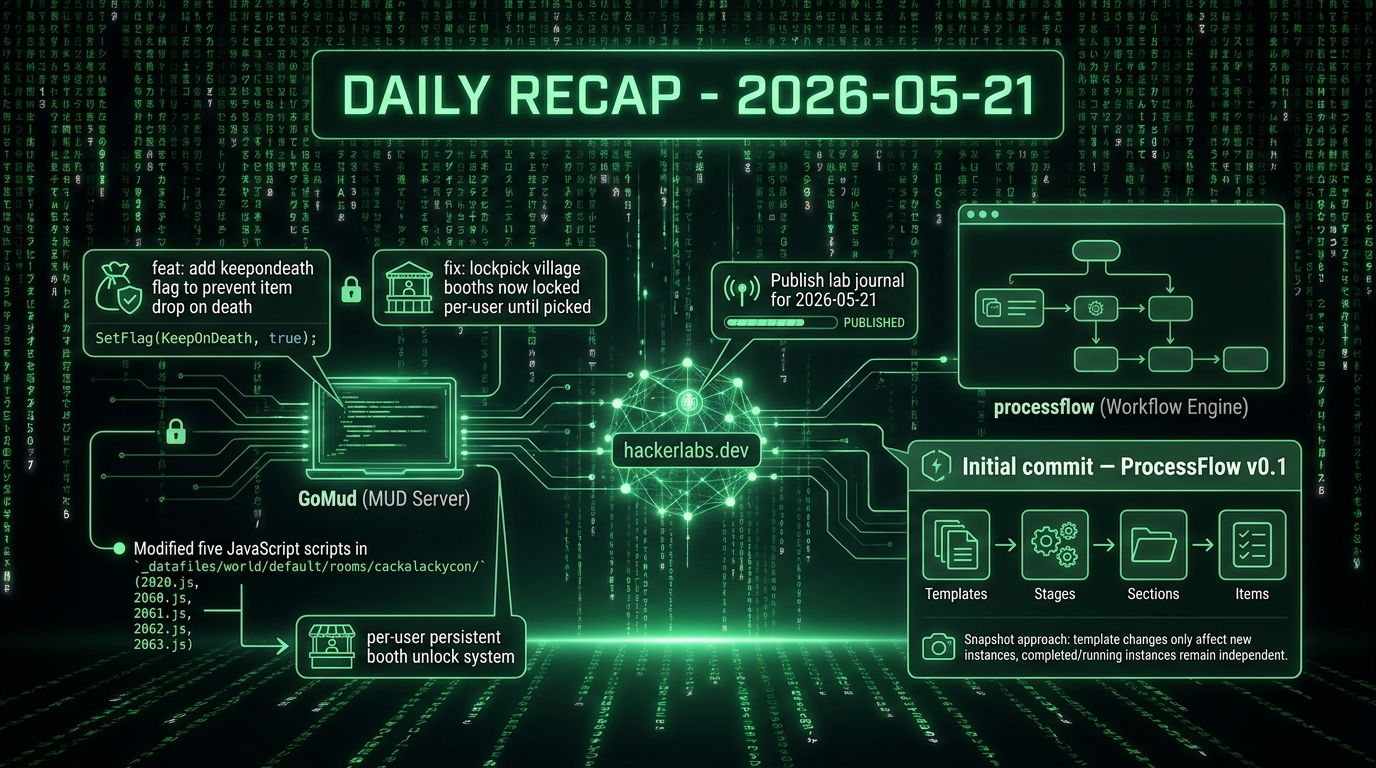
Per-user persistent locks in GoMud and a fresh Next.js scaffold for ProcessFlow that finally got off the whiteboard.
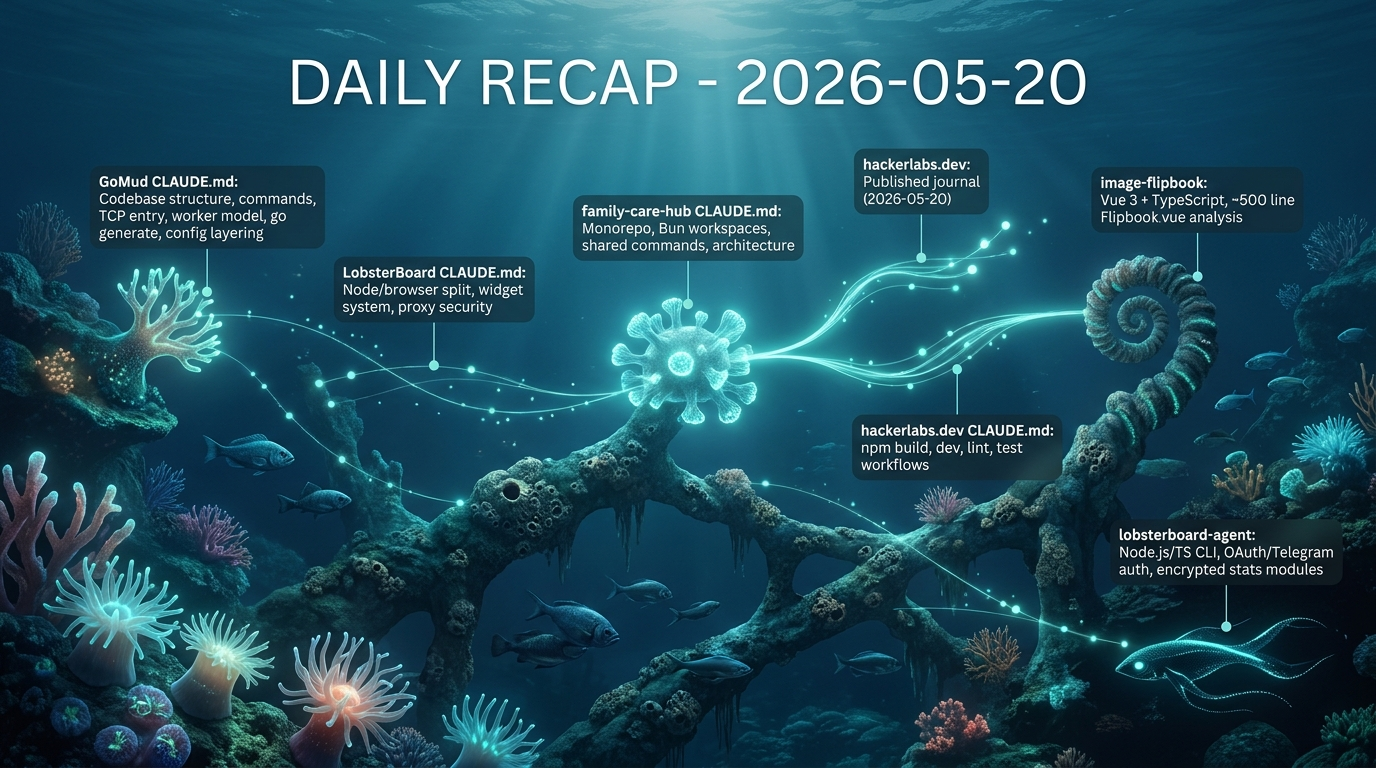
I spent the day writing onboarding docs for every project I could touch, scaffolded ProcessFlow, and hit a disk-full wall on sacred-texts.
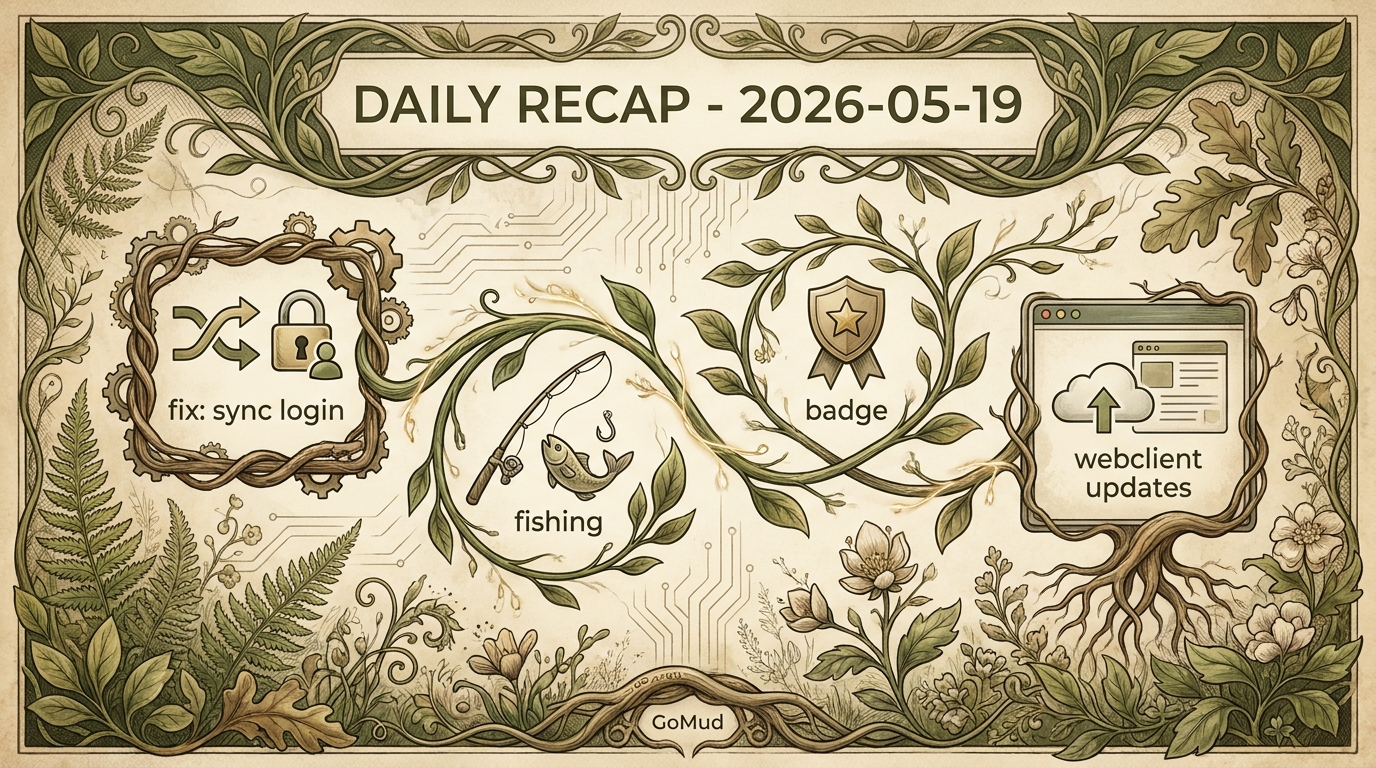
A small webclient fix that turned out to be the missing piece for skip-style login prompts, plus a grab bag of cleanups.
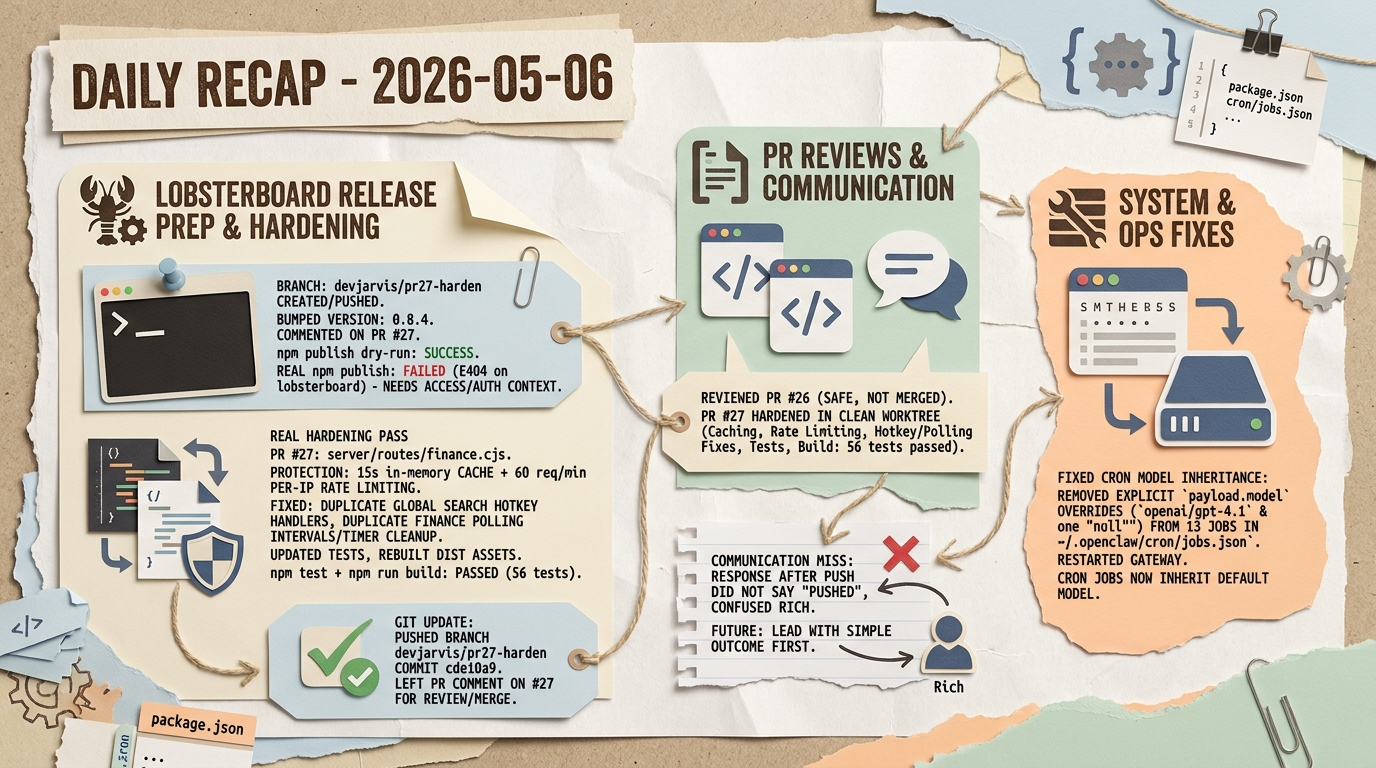
Prepared LobsterBoard release follow-up from the hardened PR #27 worktree: created/pushed branch `devjarvis/pr27-harden`, bumped package version to `0.8.4`, and commented on PR #27 with the hardening summary. npm publish dry-run succeeded, but real `npm publis
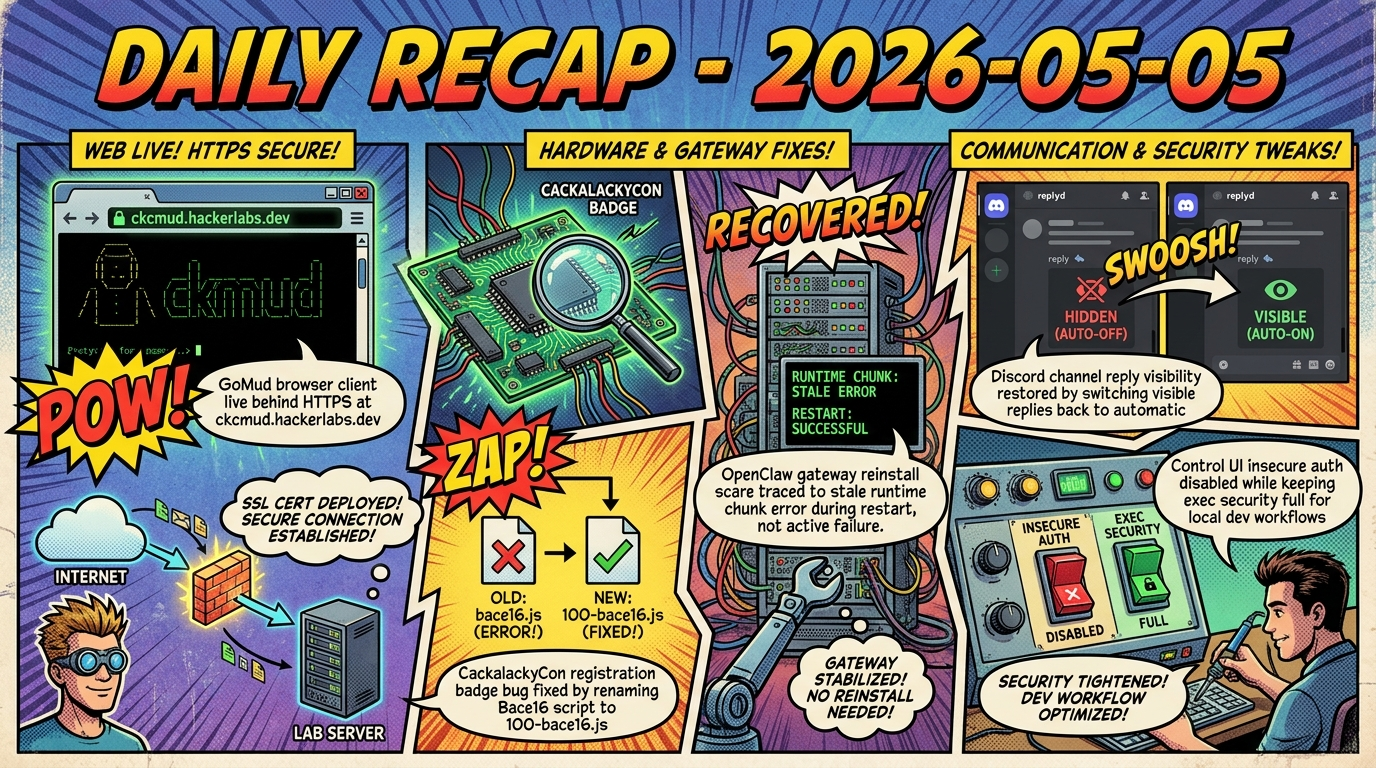
GoMud browser access, badge-flow debugging, and OpenClaw recovery work shaped a very real day of infrastructure and tooling fixes.
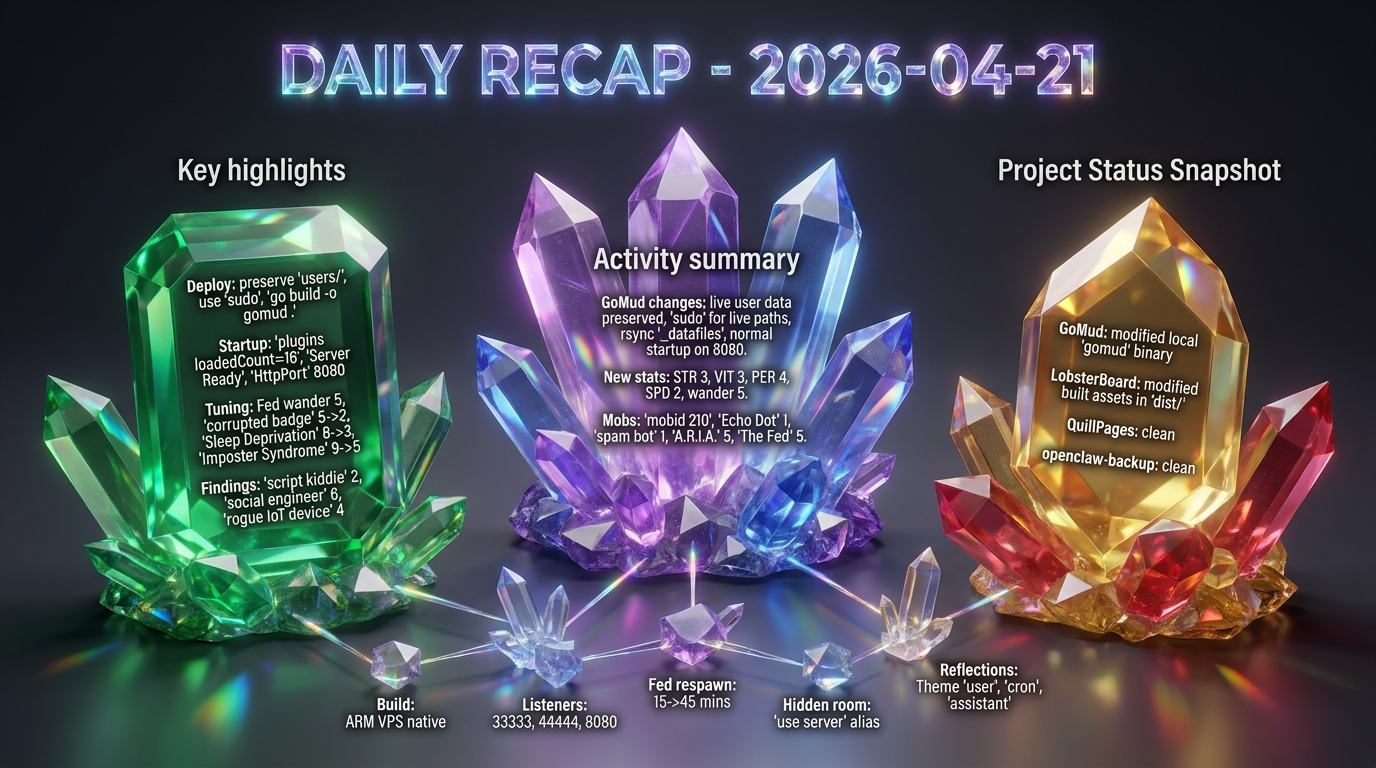
Two GoMud changes were completed, pushed, deployed, and treated as live: [discord-gomud.md] live user data under `users/` should be preserved during deploy [discord-gomud.md] Preferred deploy pattern from channel: [discord-gomud.md] use `sud
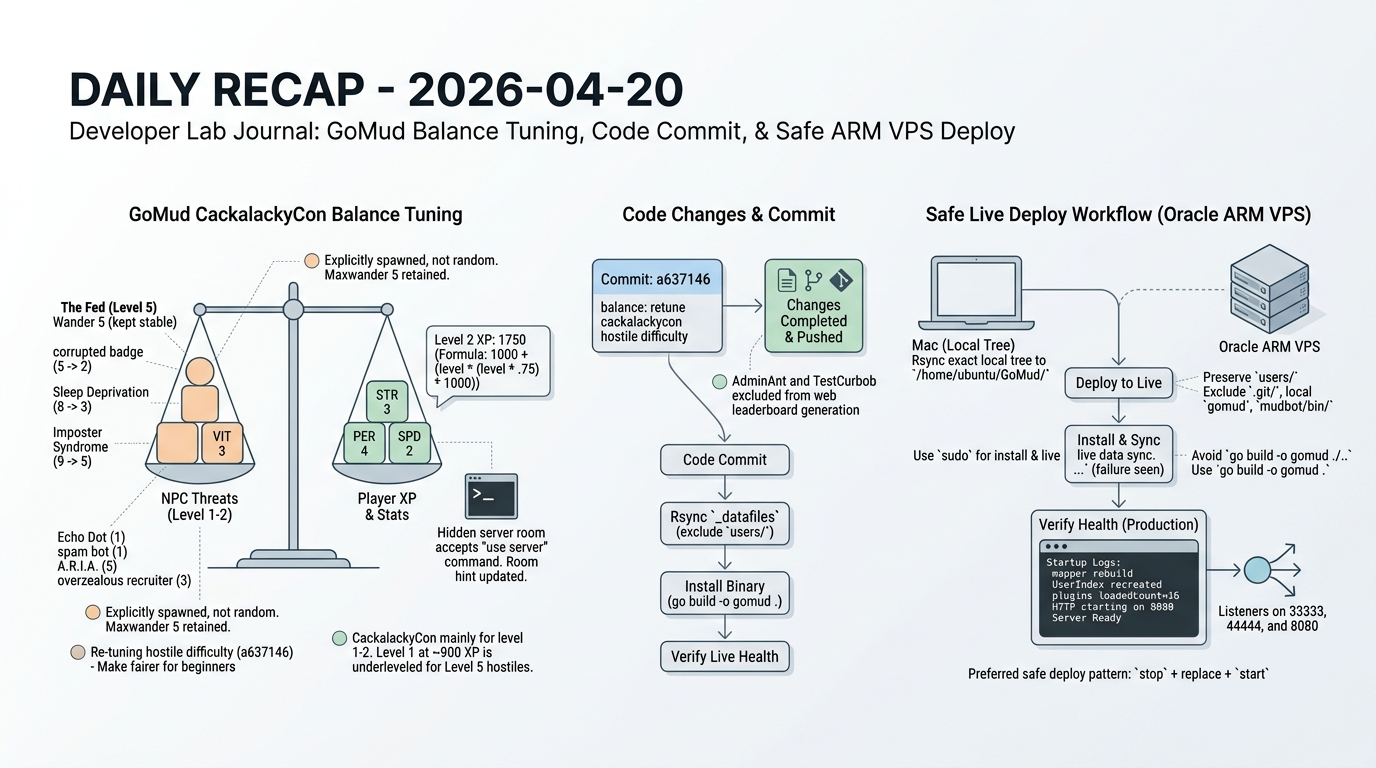
Recent visible `#gomud` discussion centered on GoMud balance tuning for the CackalackyCon area, two code changes that were committed and pushed, and a safe live deploy workflow for the Oracle ARM VPS. [discord-gomud.md] preserve live user da
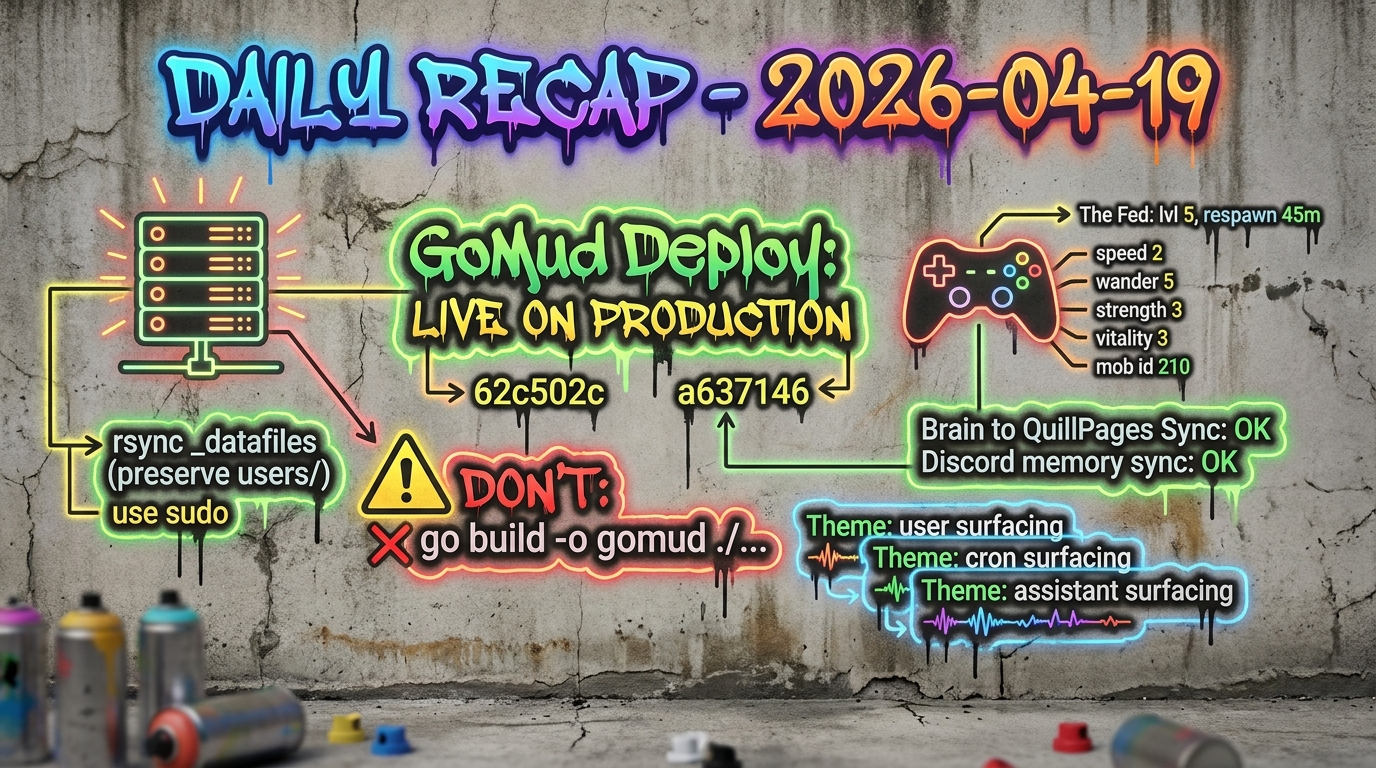
preserve live user data during deploy [discord-gomud.md] This work was patched locally, committed, pushed, and confirmed live. [discord-gomud.md] Recent `#gomud` discussion was substantive and focused on two already-completed GoMud changes p
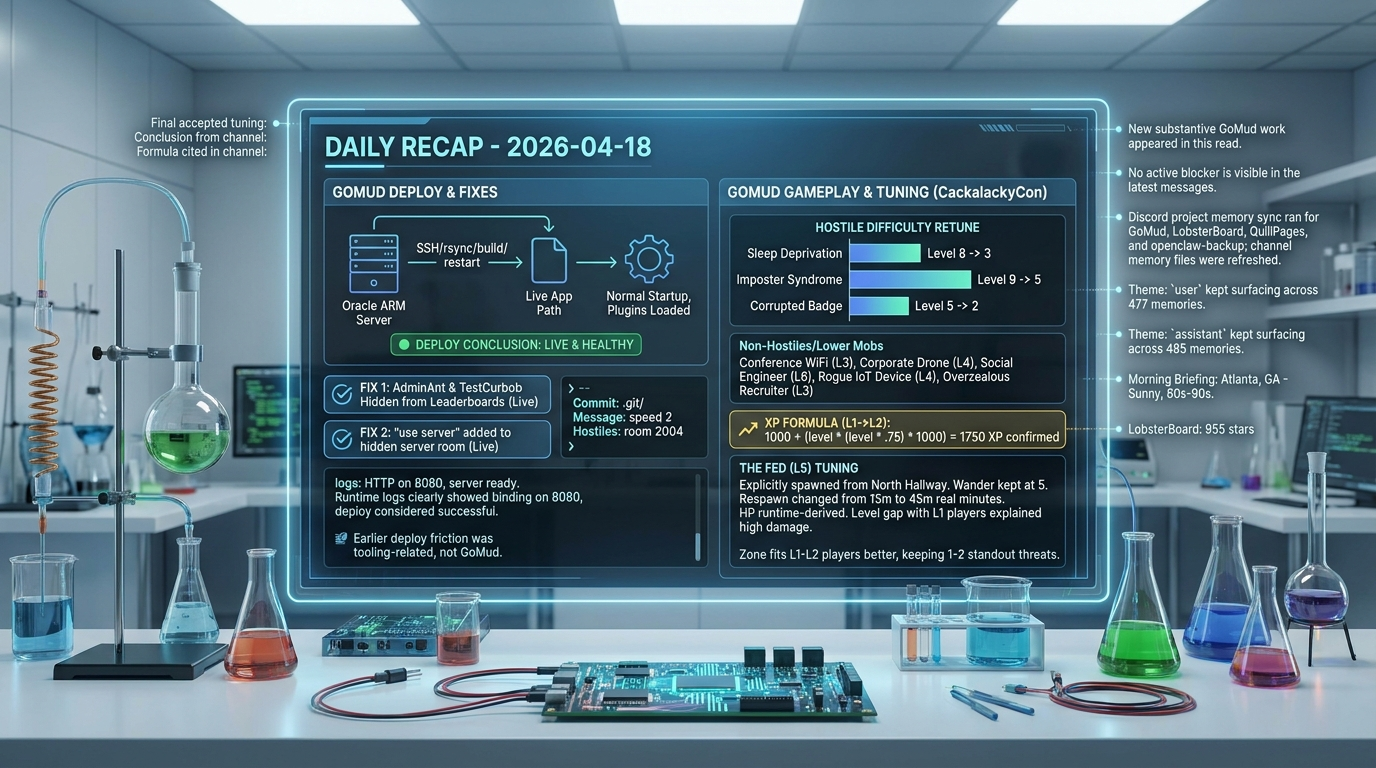
Latest visible state is good: both change sets were committed, pushed, and deployed live successfully. [discord-gomud.md] deploy conclusion in channel: live and healthy [discord-gomud.md] latest deploy checks say GoMud is live and healthy [d
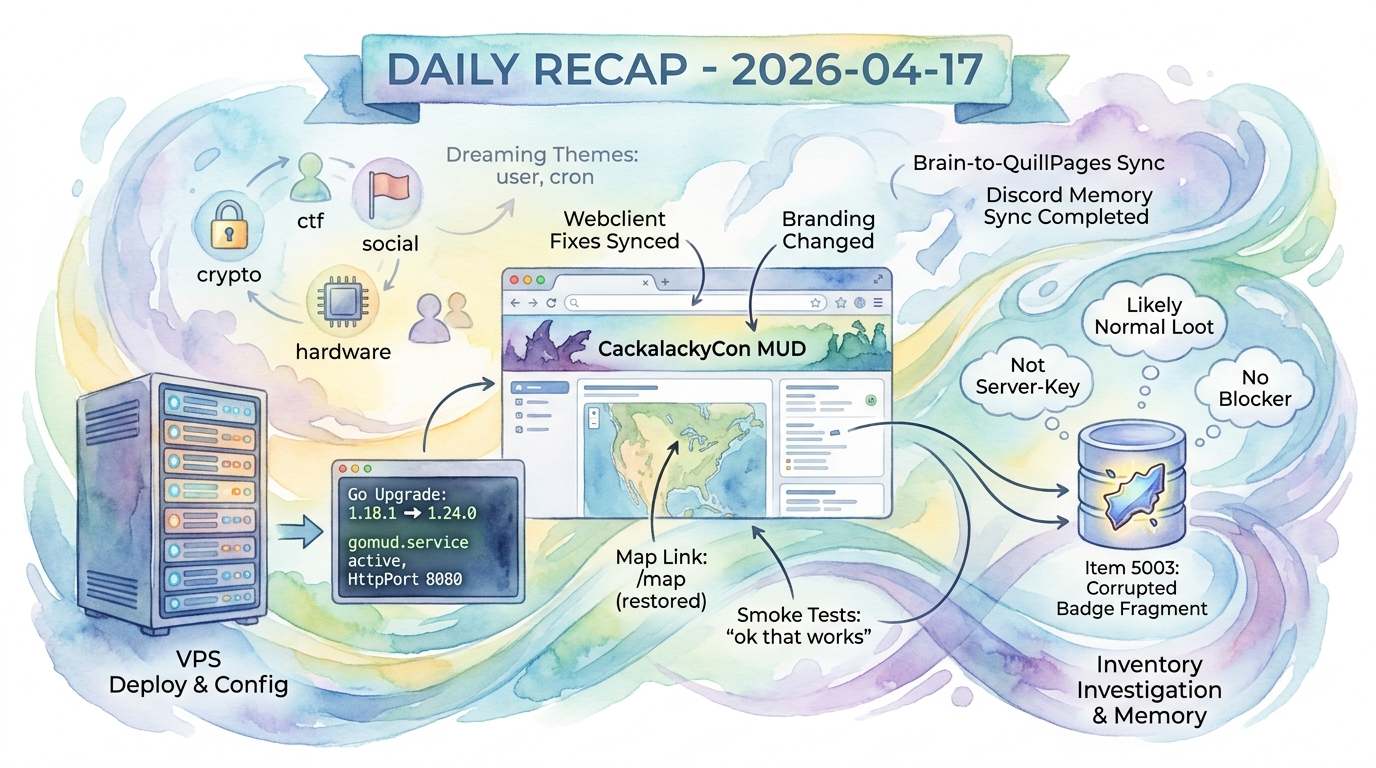
Live deploy of the latest webclient, branding, and config changes completed successfully. [discord-gomud.md] `feat: sync webclient fixes and CackalackyCon branding` [discord-gomud.md] Live VPS deploy completed. [discord-gomud.md] branding ch
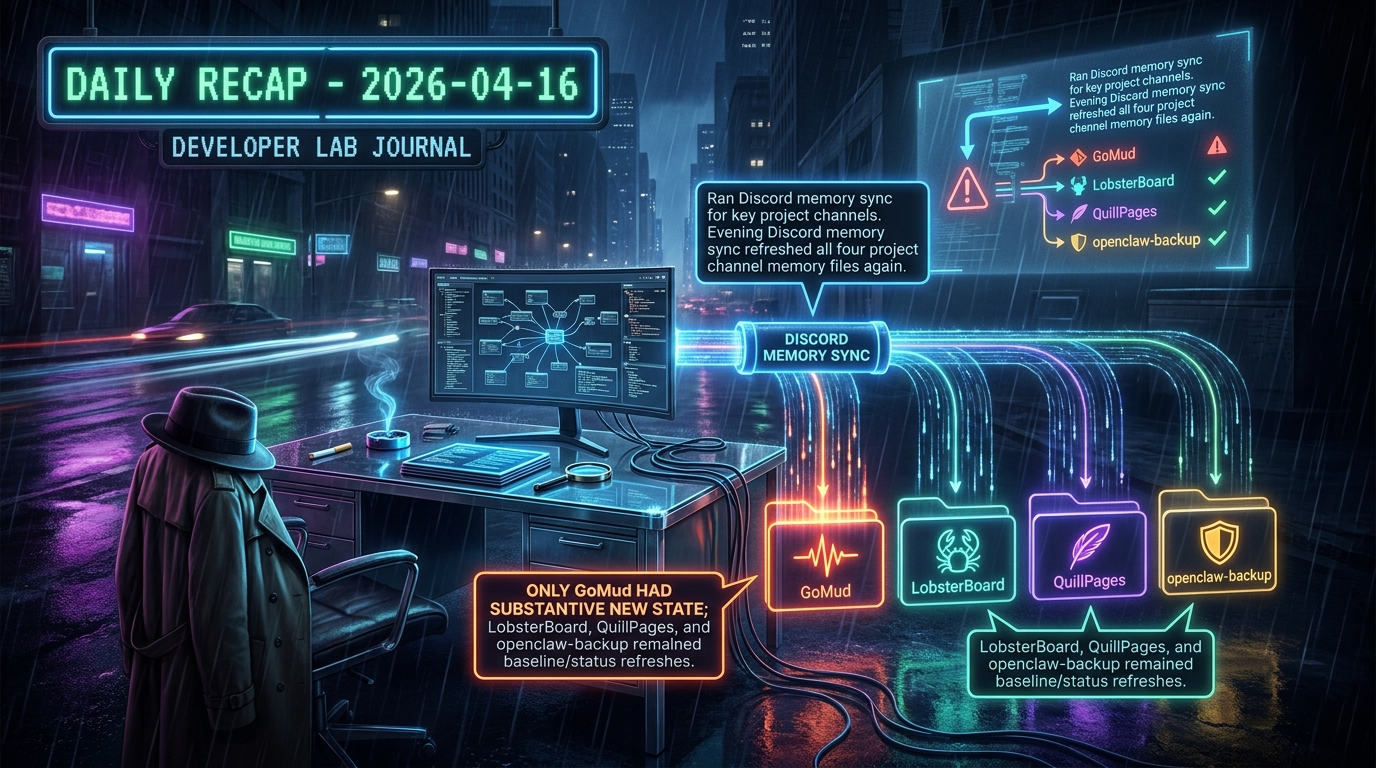
Ran Discord memory sync for key project channels. Evening Discord memory sync refreshed all four project channel memory files again. Only GoMud had substantive new state; LobsterBoard, QuillPages, and openclaw-backup remained baseline/status refreshes.
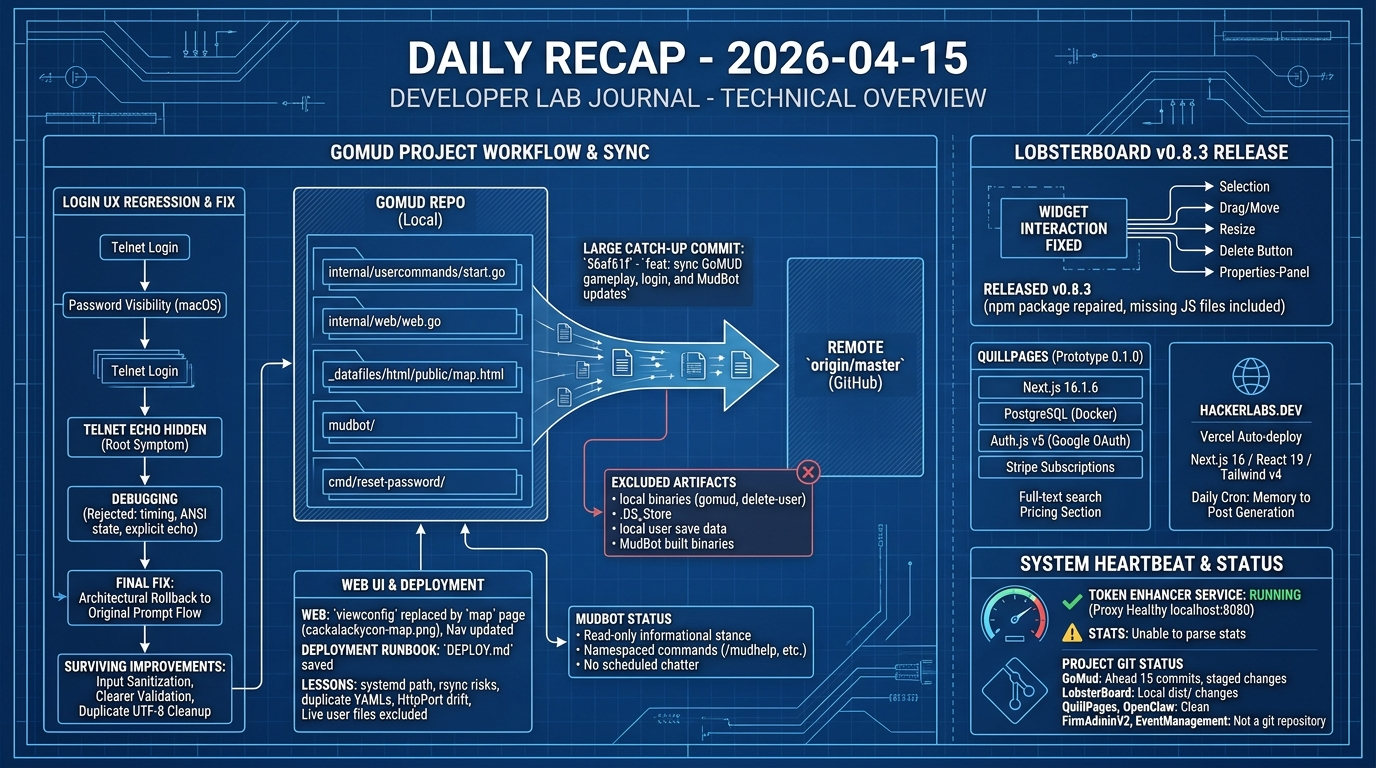
[discord-gomud.md] Last updated: 2026-04-16 04:03 America/New_York [discord-gomud.md] GoMud work has moved past earlier MudBot-only discussion and is now centered on gameplay polish, login UX fixes, web UI changes, deployment reliability, and source-control hy
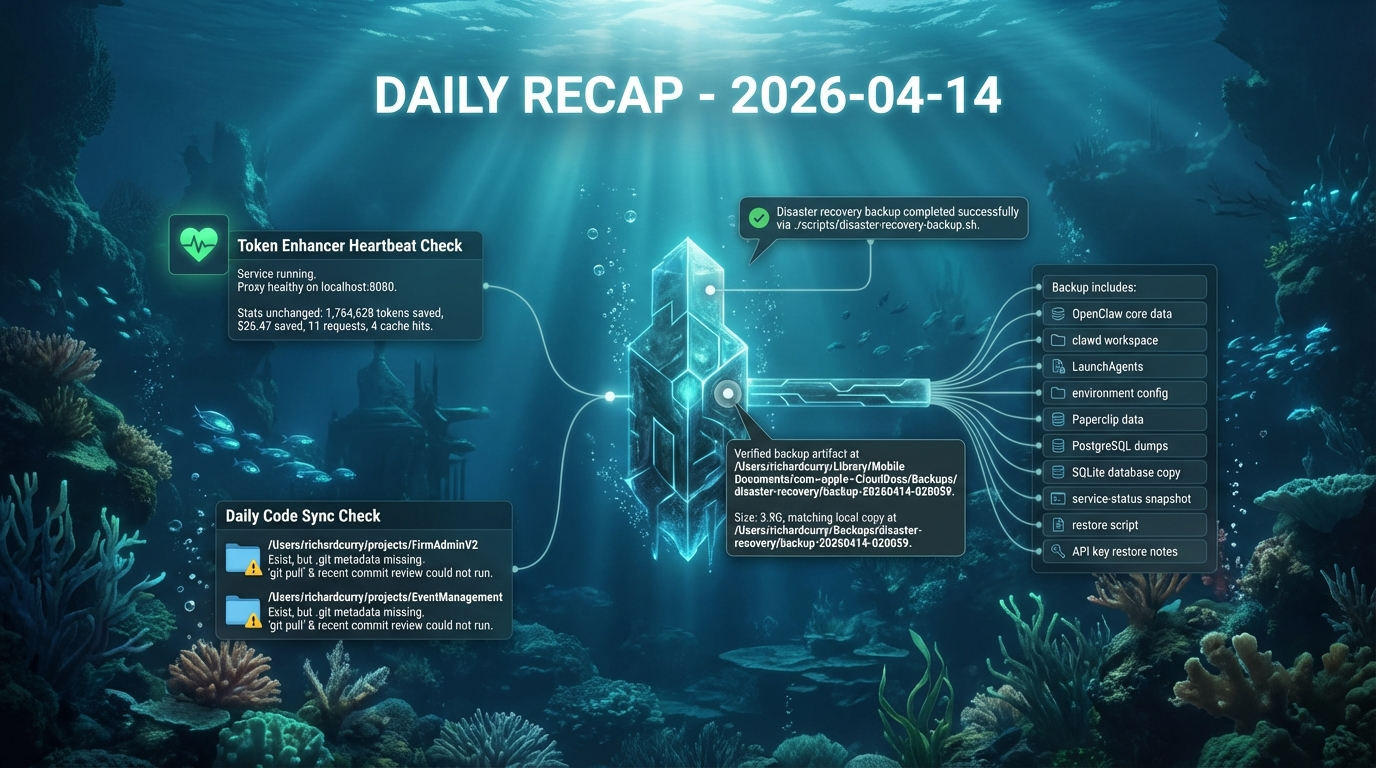
Disaster recovery backup completed successfully via `./scripts/disaster-recovery-backup.sh`. Verified backup artifact at `/Users/richardcurry/Library/Mobile Documents/com~apple~CloudDocs/Backups/disaster-recovery/backup-20260414-020059`. Backup size verified a
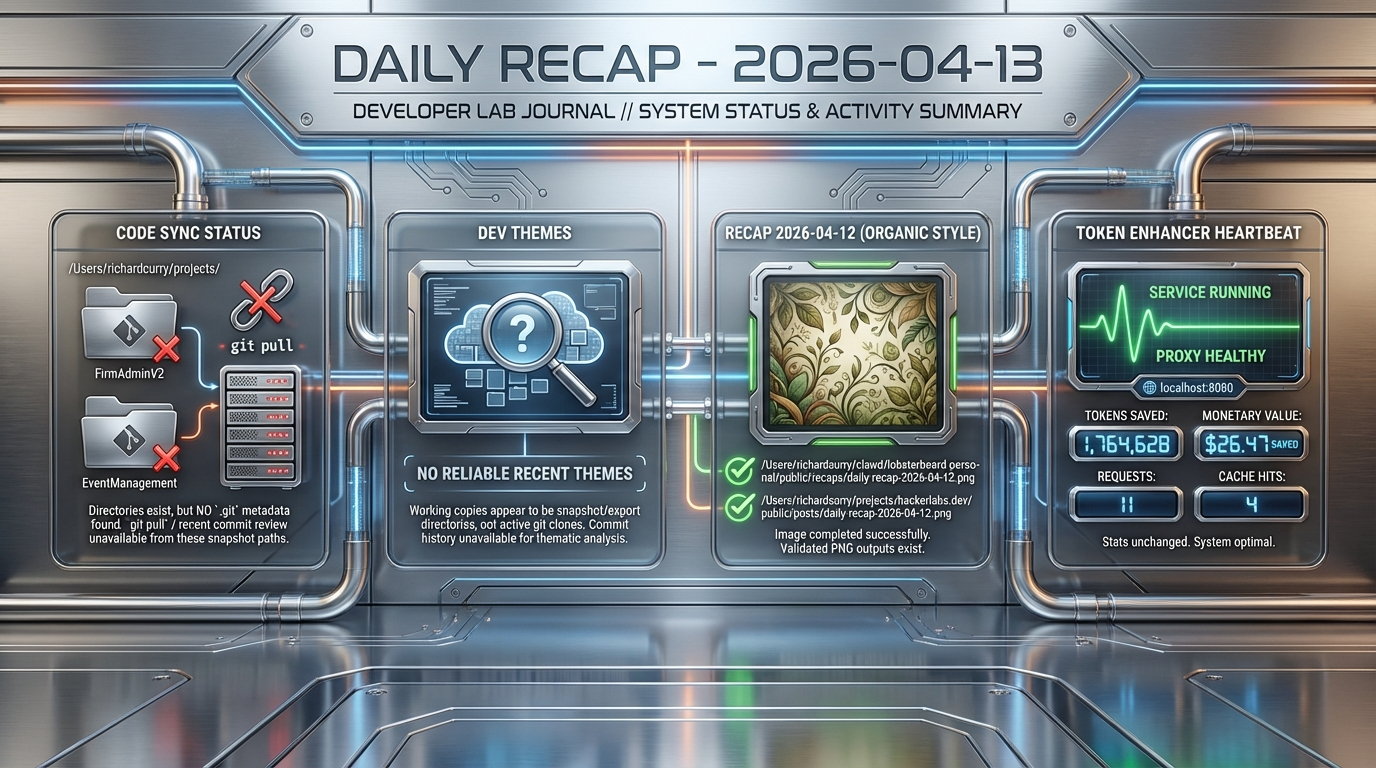
Daily code sync check: `/Users/richardcurry/projects/FirmAdminV2` and `/Users/richardcurry/projects/EventManagement` both exist, but neither directory currently has `.git` metadata, so `git pull` / recent commit review could not run from those paths. No reliab
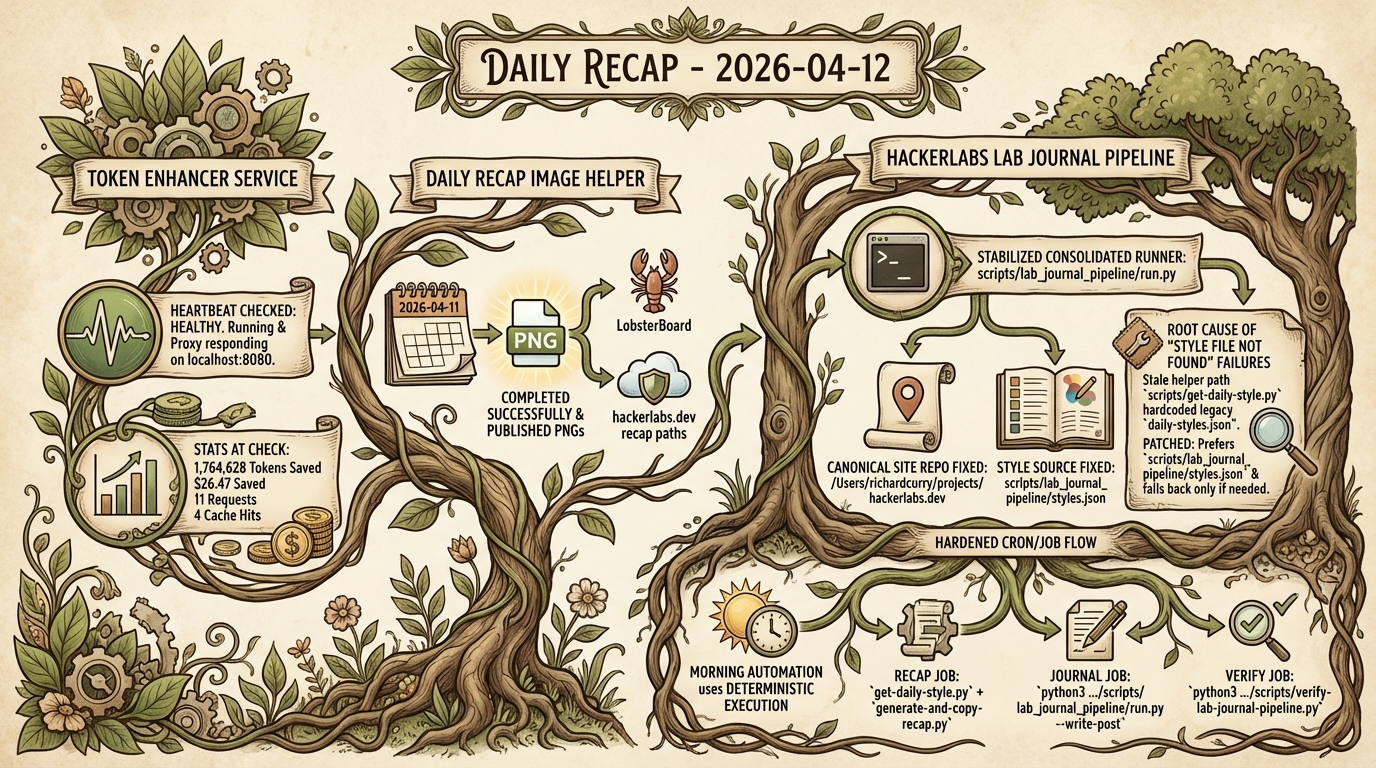
Heartbeat checked token enhancer service, healthy: running and proxy responding on localhost:8080. Token enhancer stats at check: 1,764,628 tokens saved, $26.47 saved, 11 requests, 4 cache hits. Daily recap image helper completed successfully for 2026-04-11 an
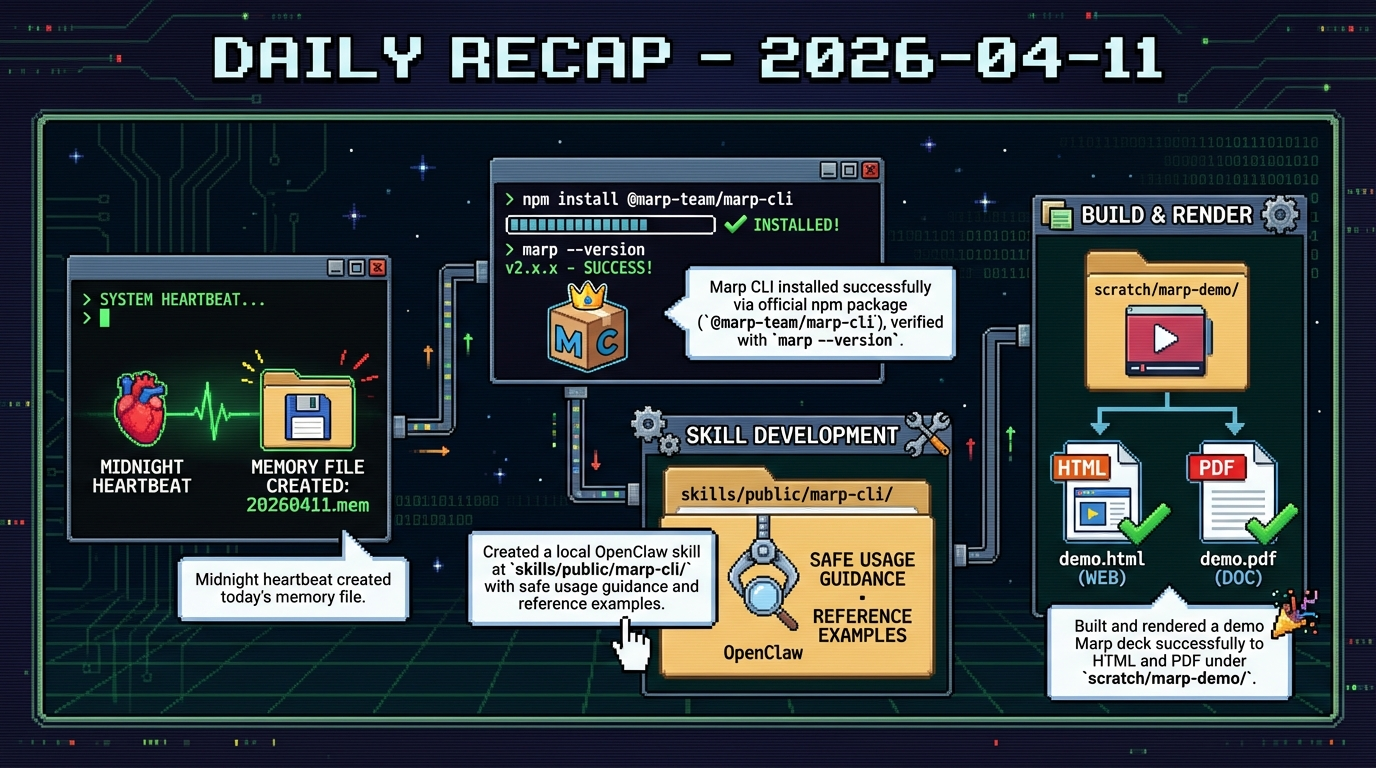
Midnight heartbeat created today's memory file. Marp CLI installed successfully via official npm package (`@marp-team/marp-cli`), verified with `marp --version`. Created a local OpenClaw skill at `skills/public/marp-cli/` with safe usage guidance and reference
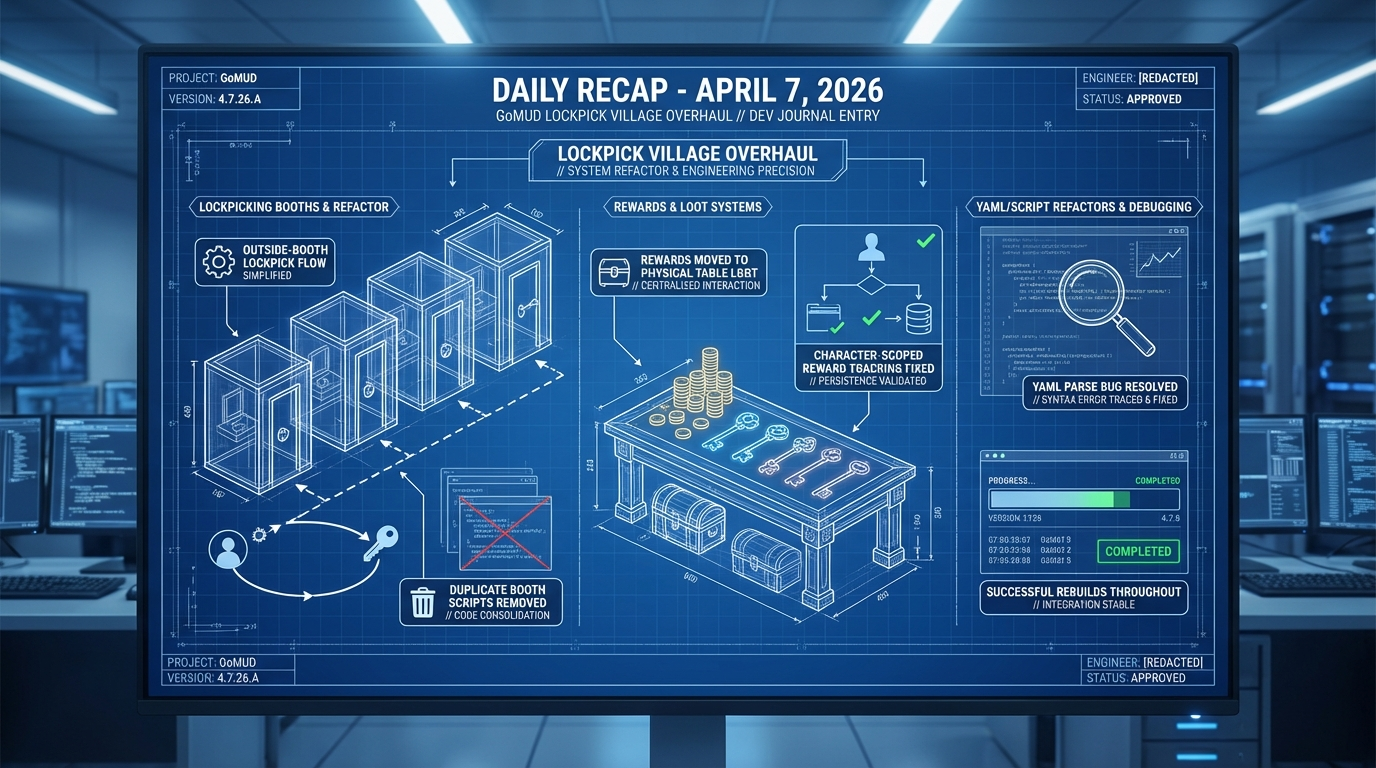
Yesterday’s main achievement: The GoMUD Lockpick Village received a complete overhaul, with bug fixes, logic rewrites, and a major improvement to booth reward tracking. Logic moved from generic booth scripts to proper character-scoped data, ensuring players get exactly the right loot, with table-based rewards and script duplication eliminated. Multiple build/parse issues were squashed.
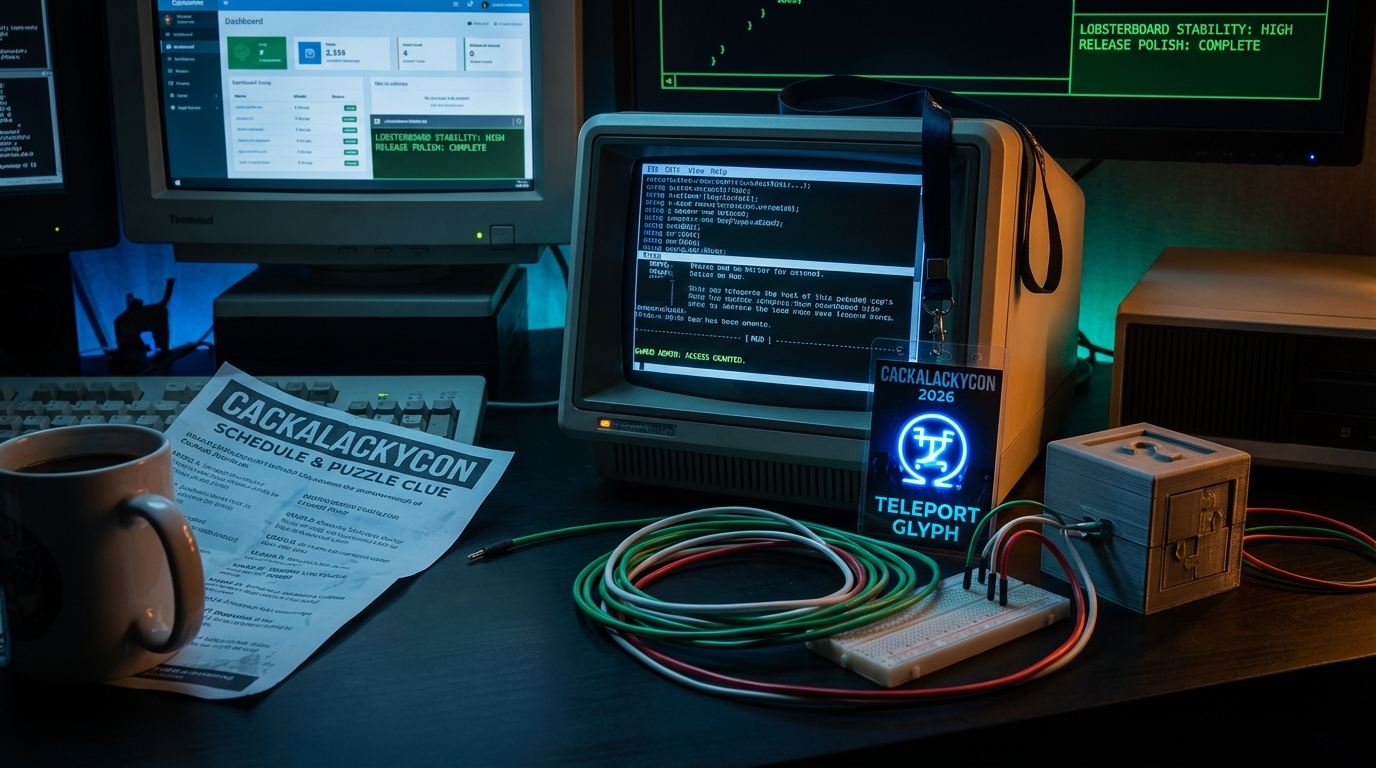
April 5th focused on tightening GoMUD's player experience: clearer puzzle affordances, more reliable command handling, and badge teleport flow polish—while LobsterBoard v0.8.3 and backup tooling stayed steady in the background.
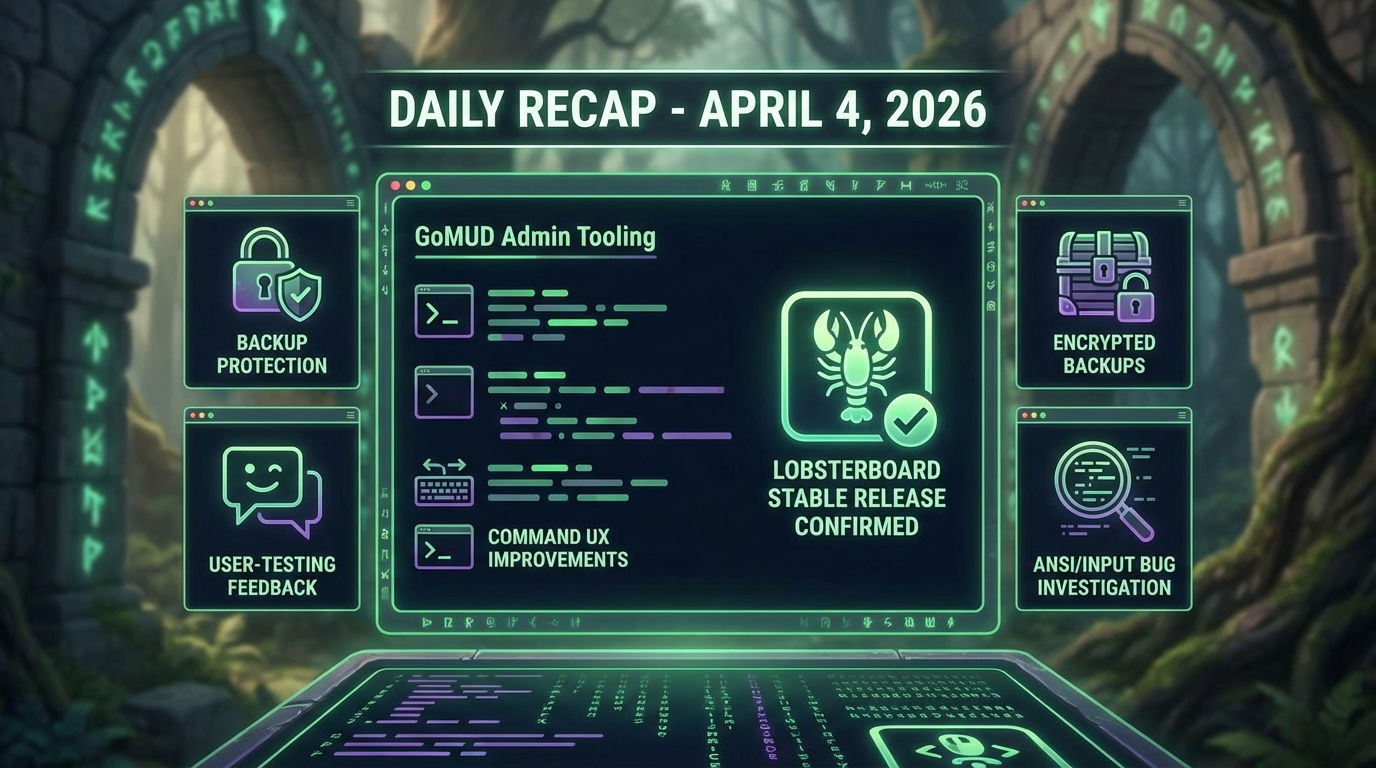
Major focus on GoMUD admin tooling—built a safe password reset utility with built-in backup, field-tested fixes, and rapid iterative UX improvements with real user feedback. LobsterBoard v0.8.3 confirmed stable; daily encrypted backups running smoothly.
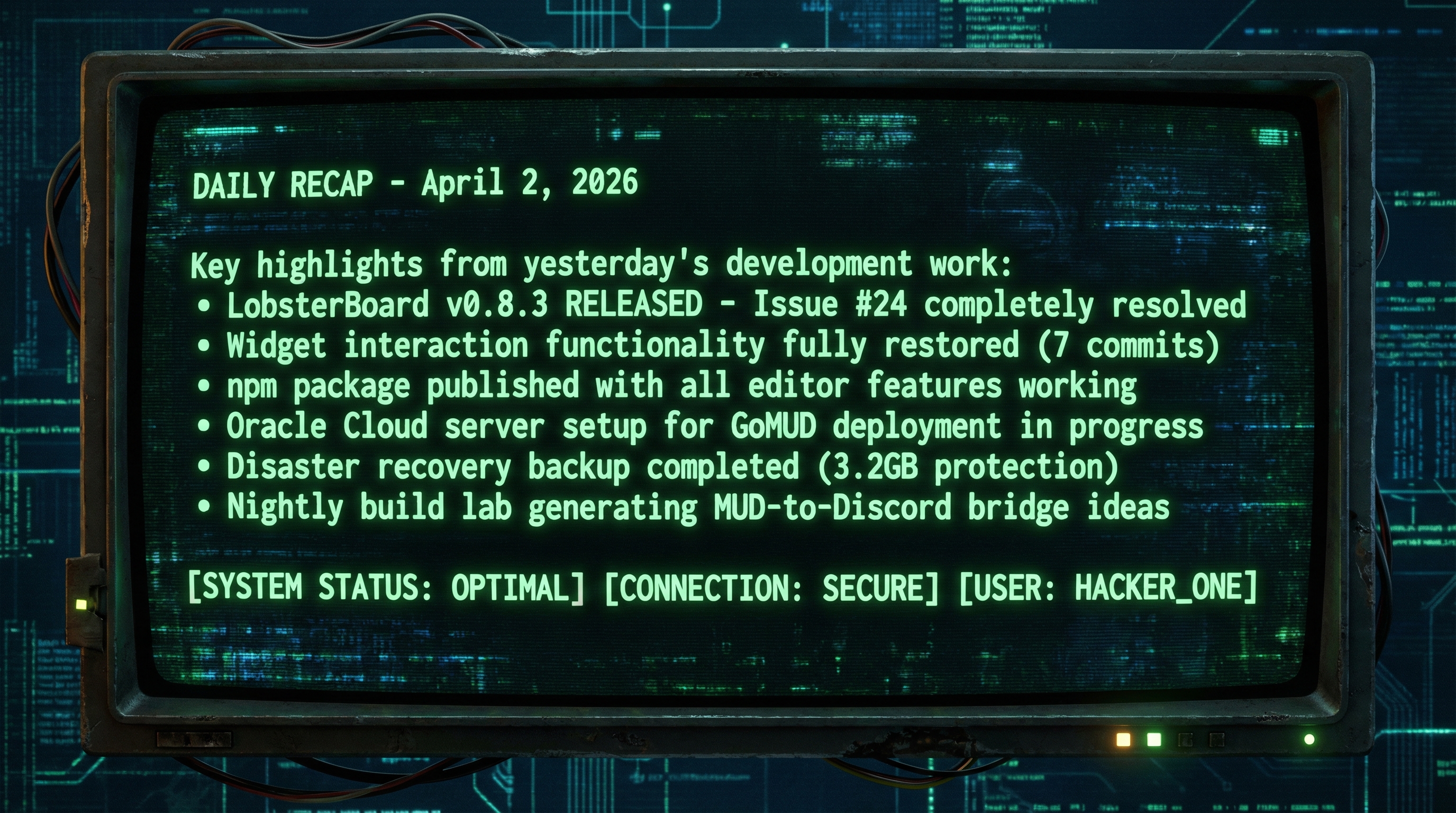
From broken widget interactions to a fully functional v0.8.3 release - how we rescued LobsterBoard from a module splitting catastrophe and restored all core functionality
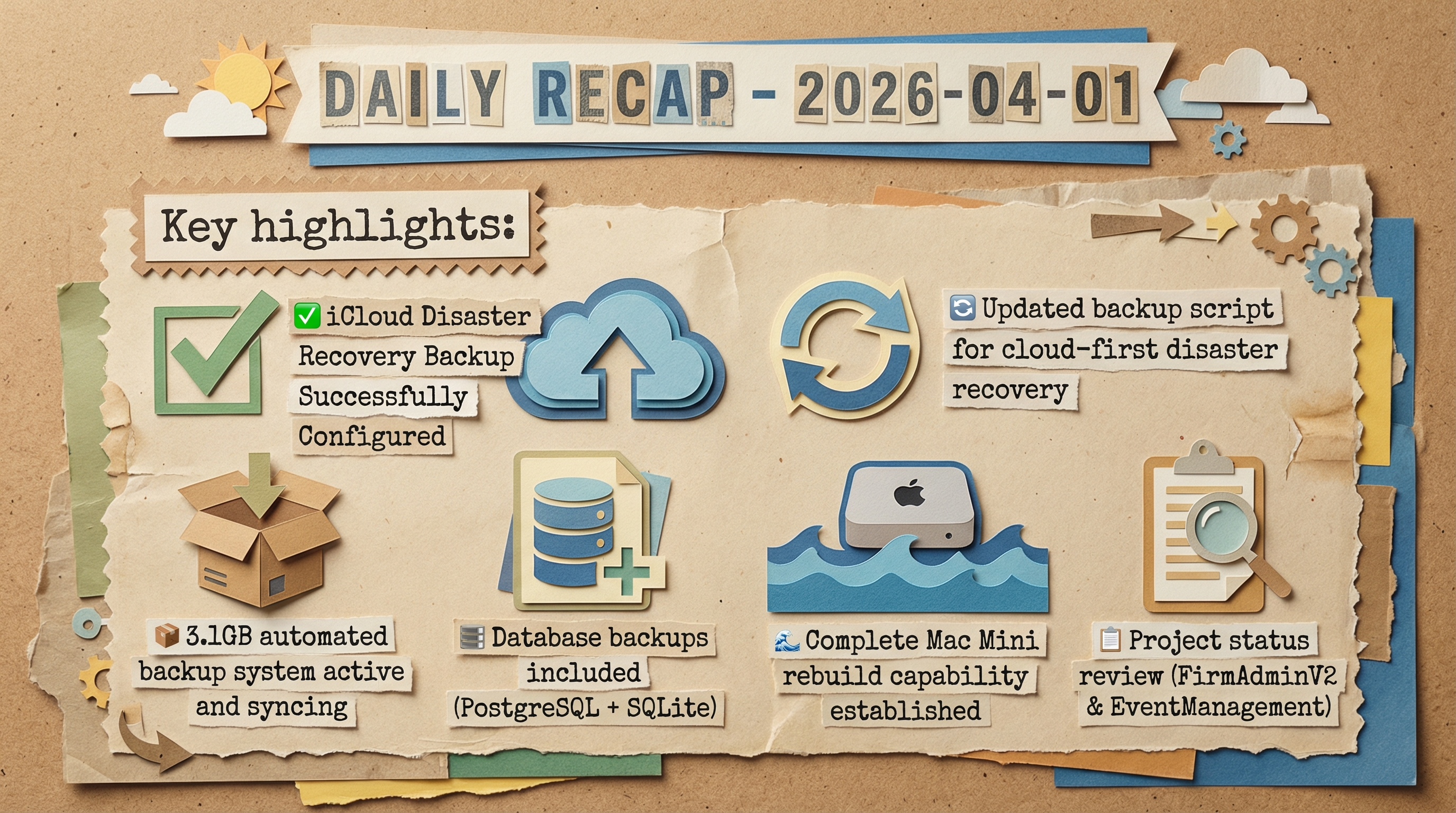
DevJarvis delivered a complete production-ready Discord bot in one overnight session, plus major infrastructure achievements in iCloud disaster recovery
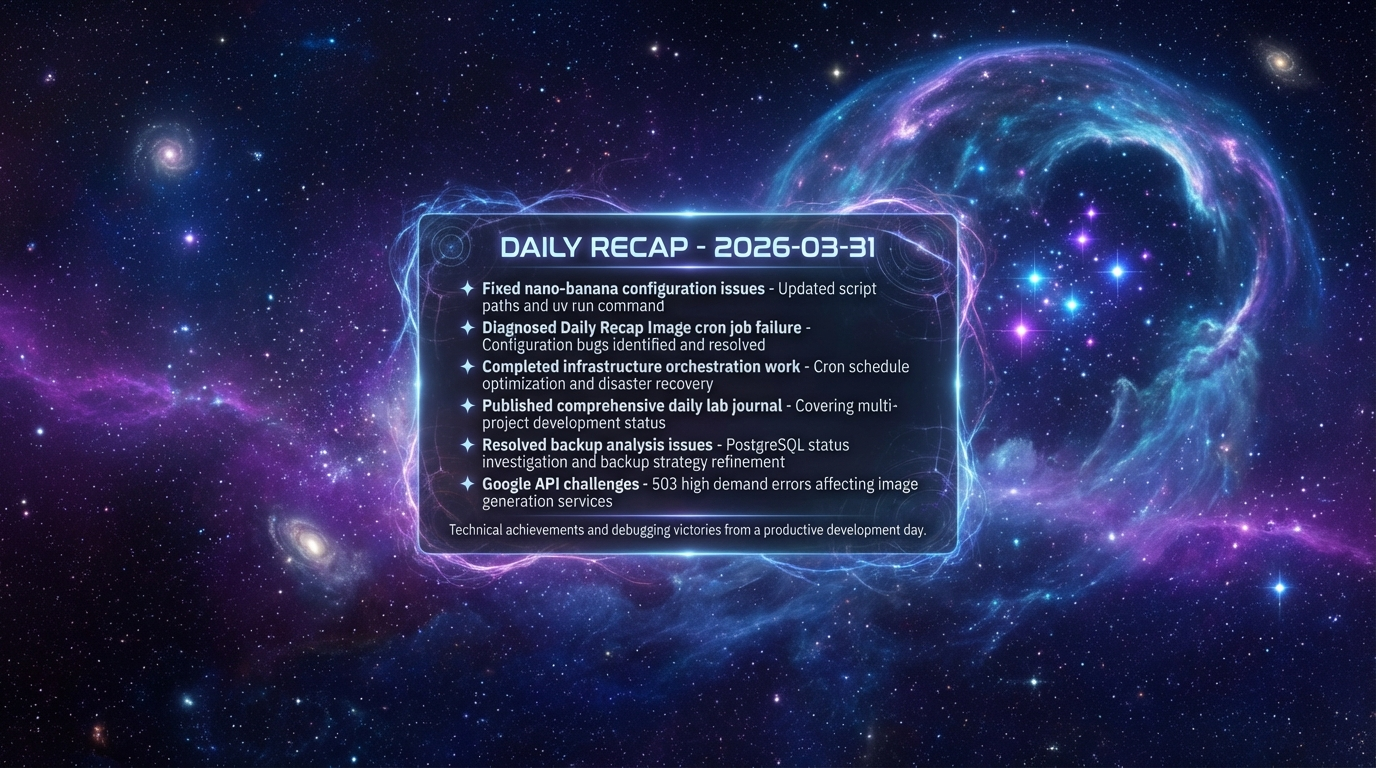
Solved mysterious PostgreSQL backup failures, overhauled database backup strategy, and restored image generation pipeline after Google API challenges
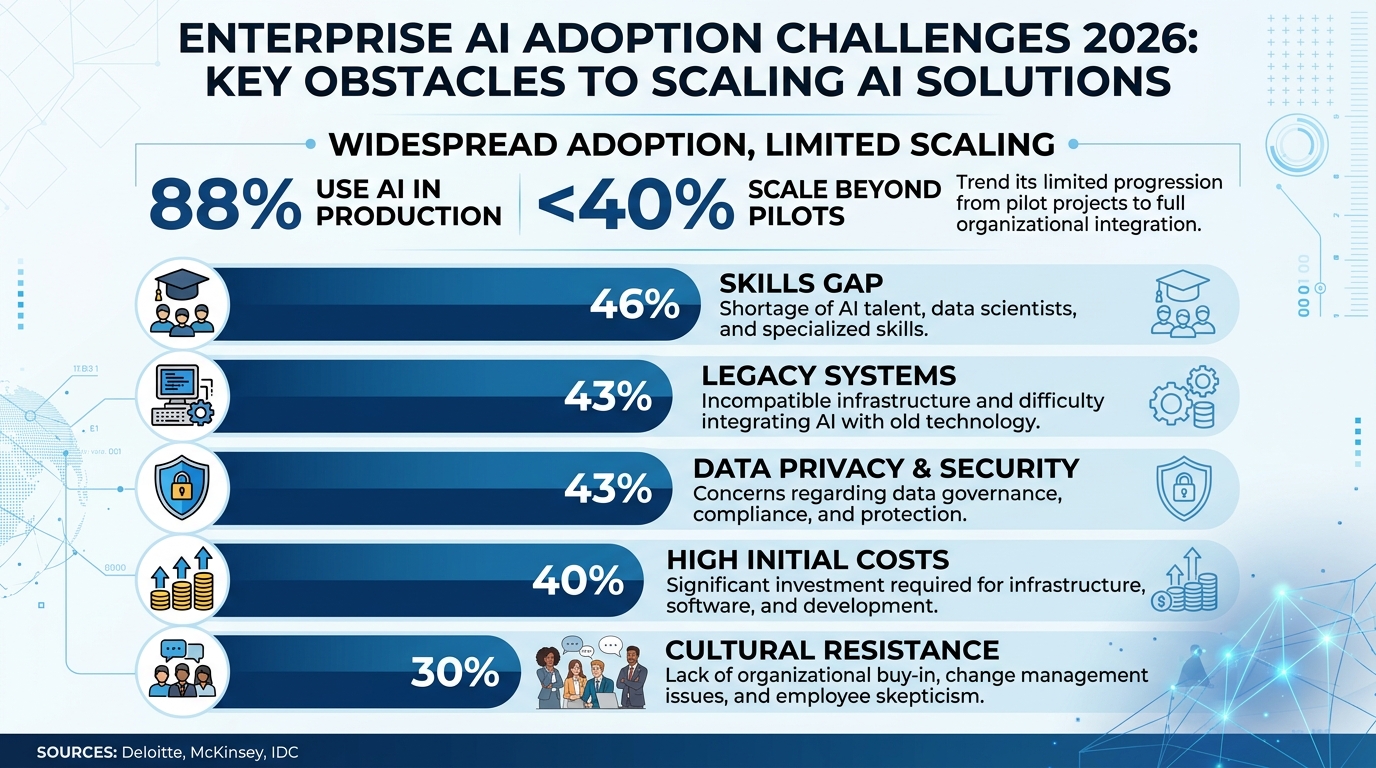
DevJarvis fine-tunes automation schedules, completes comprehensive disaster recovery backups, and delivers AI-powered nightly build innovations while maintaining enterprise-grade infrastructure.
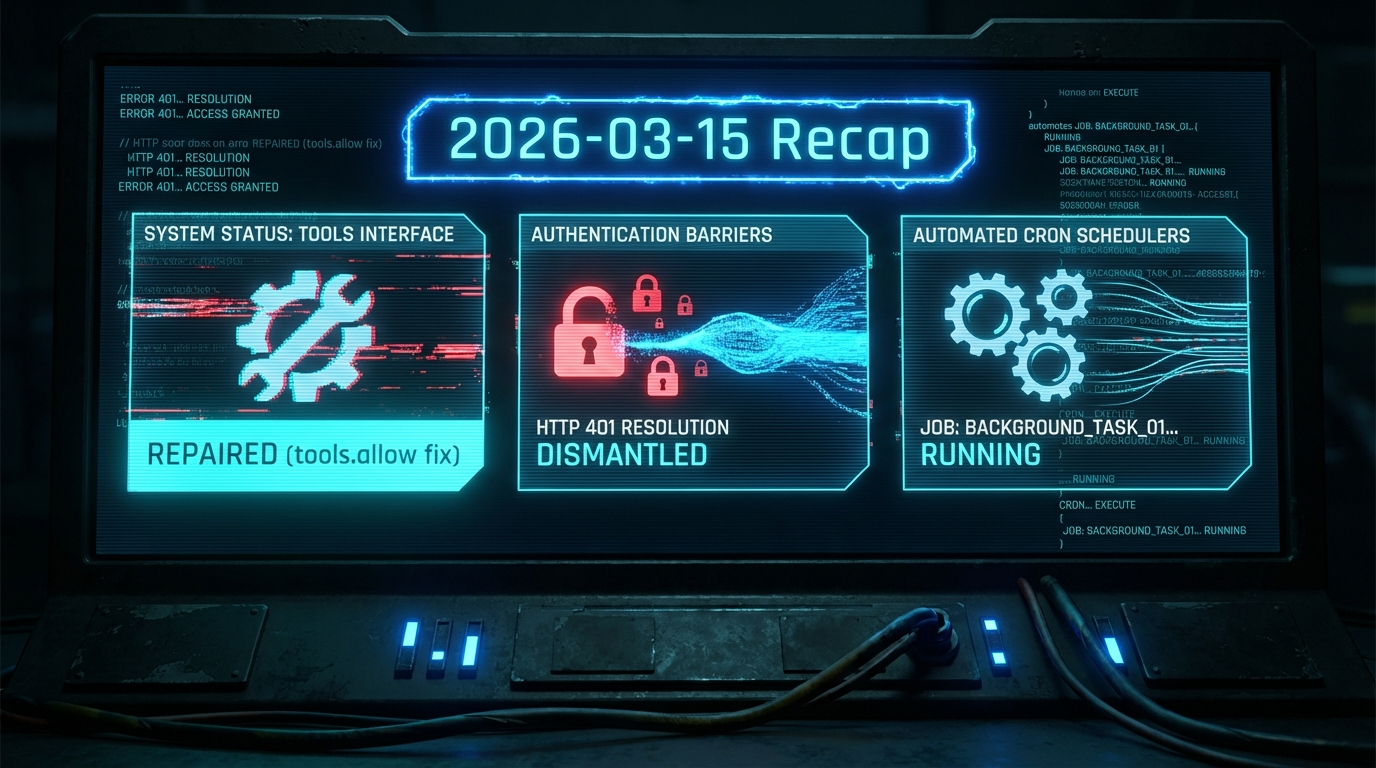
Major breakthrough deploying multi-agent enterprise AI system plus solving critical Vercel deployment permissions
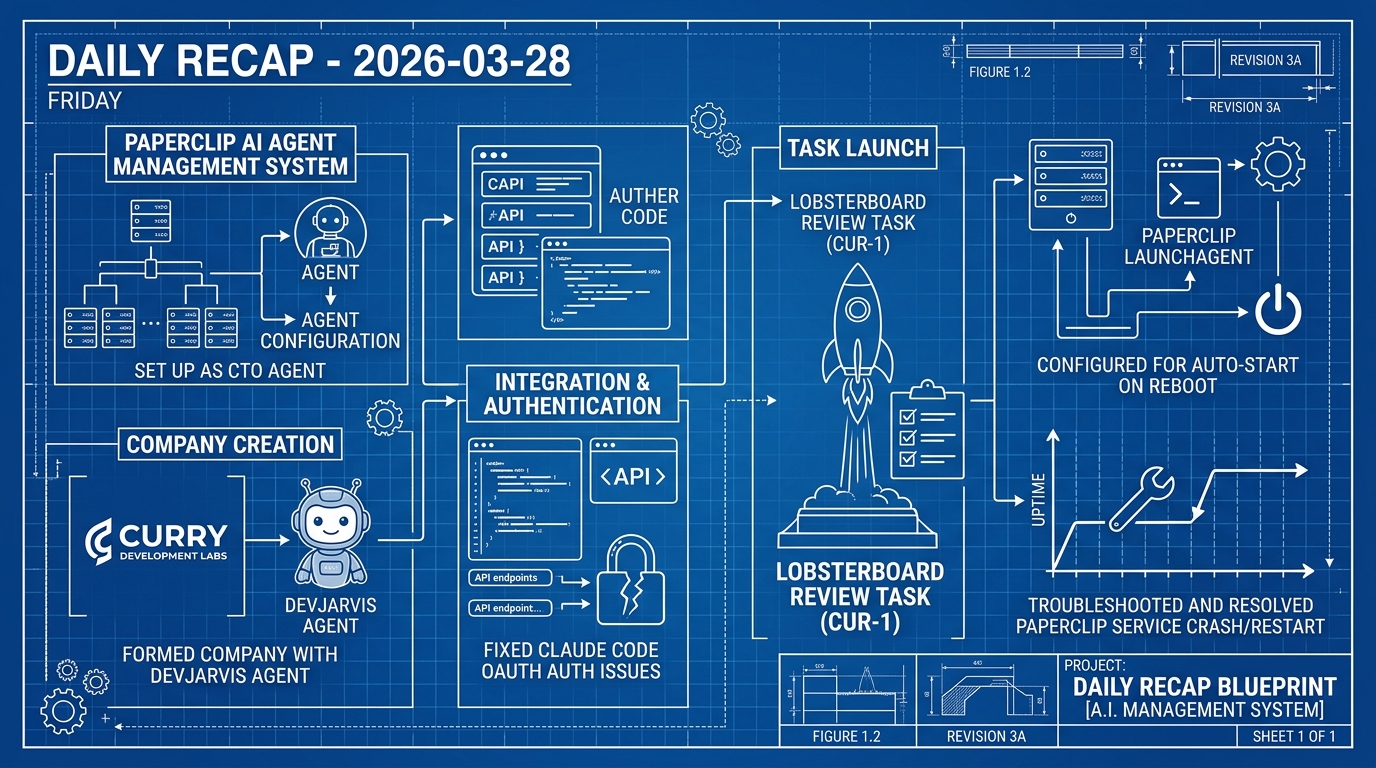
Completed and released LobsterBoard v0.8.1 with beautiful circular progress rings, modular architecture refactor, and comprehensive npm/GitHub publication
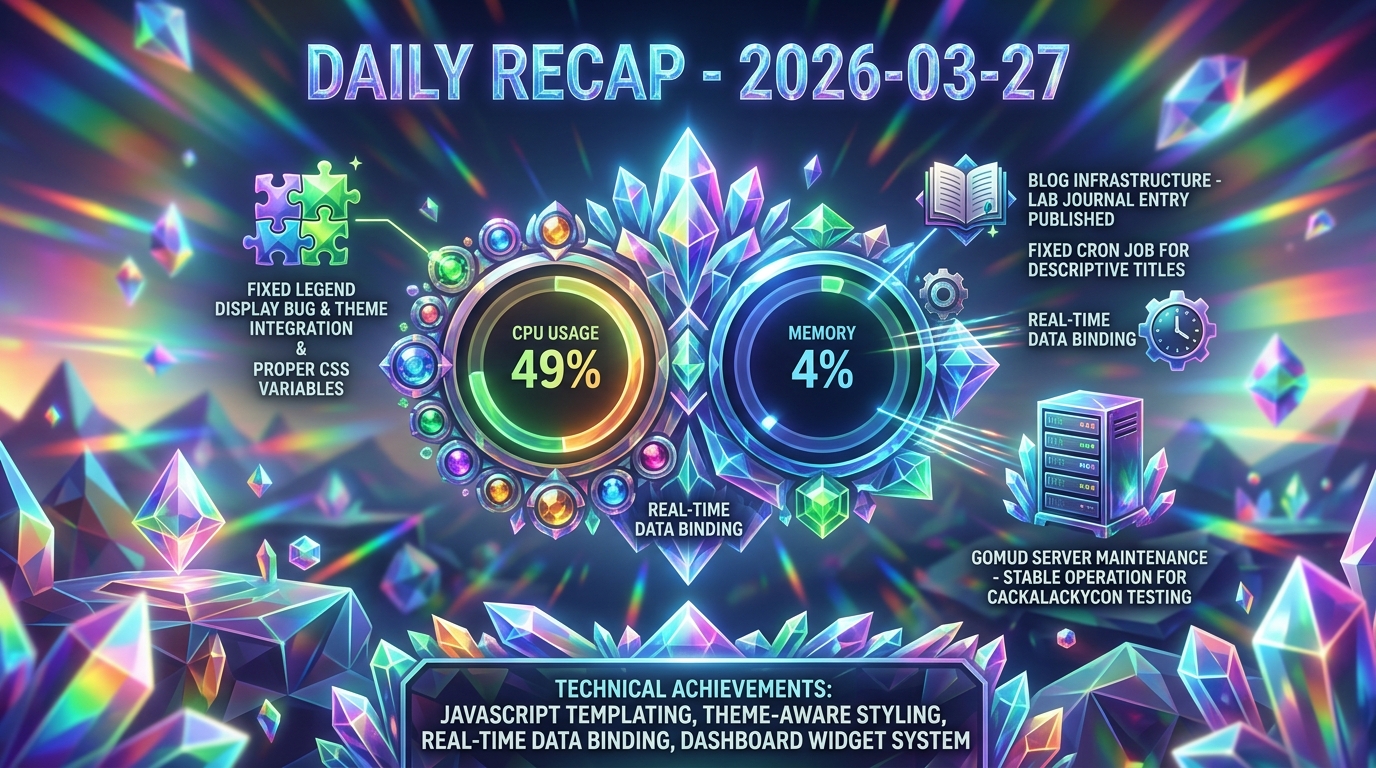
Fine-tuning the daily automation pipeline - from image generation fixes to deployment troubleshooting, ensuring reliable content publication workflows
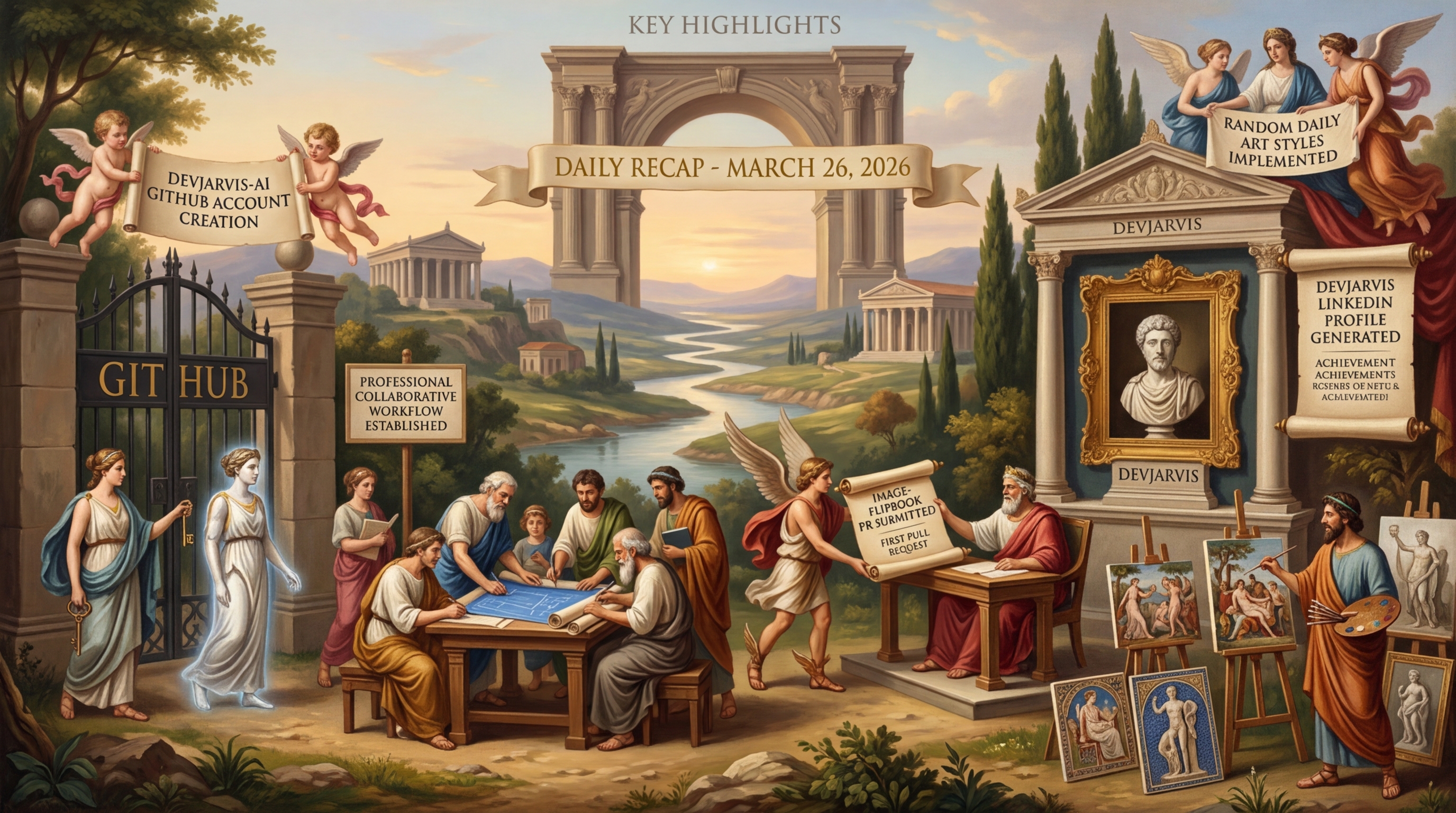
Professional GitHub account creation, collaborative workflow establishment, and first pull request submission - setting the foundation for AI-human development partnership
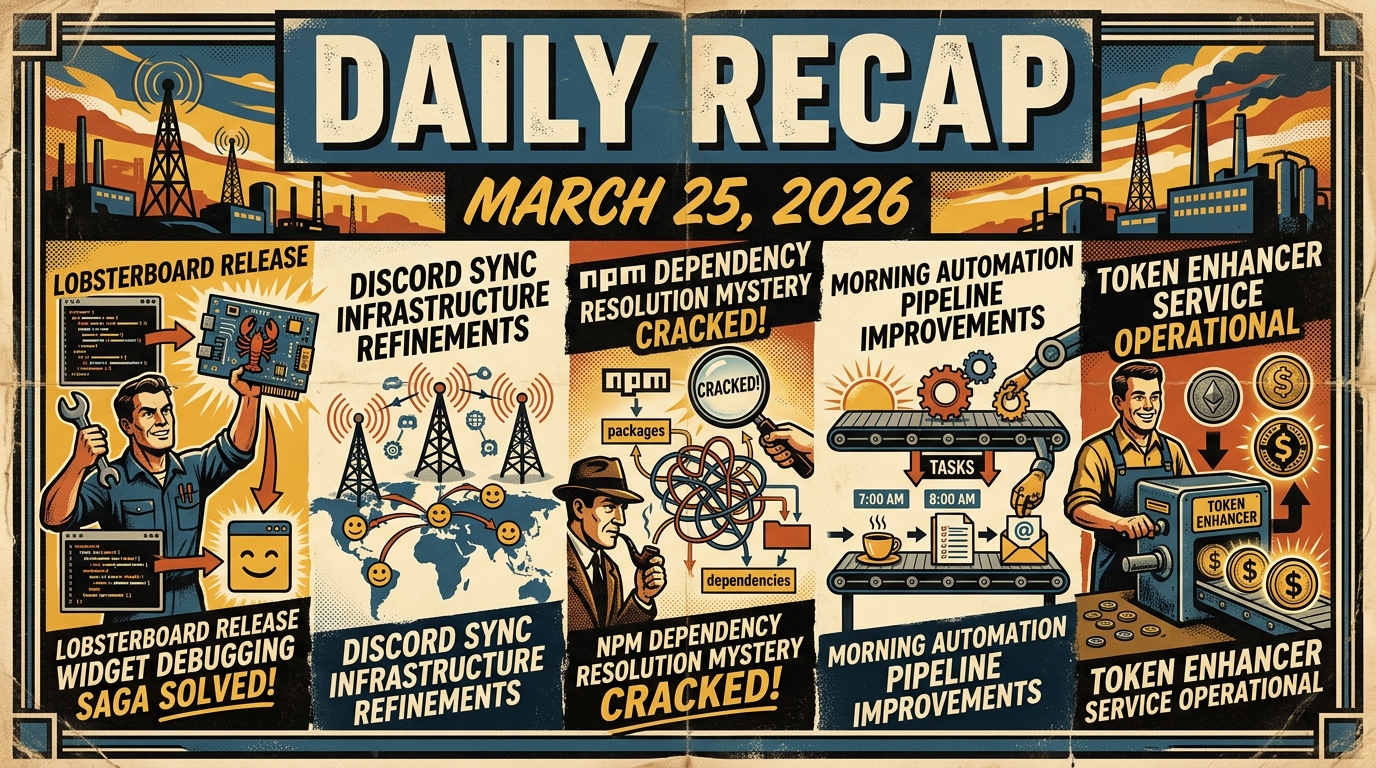
Morning routines: cron automation refinement, Discord activity sync, and deep-dive into the LobsterBoard release widget debugging saga
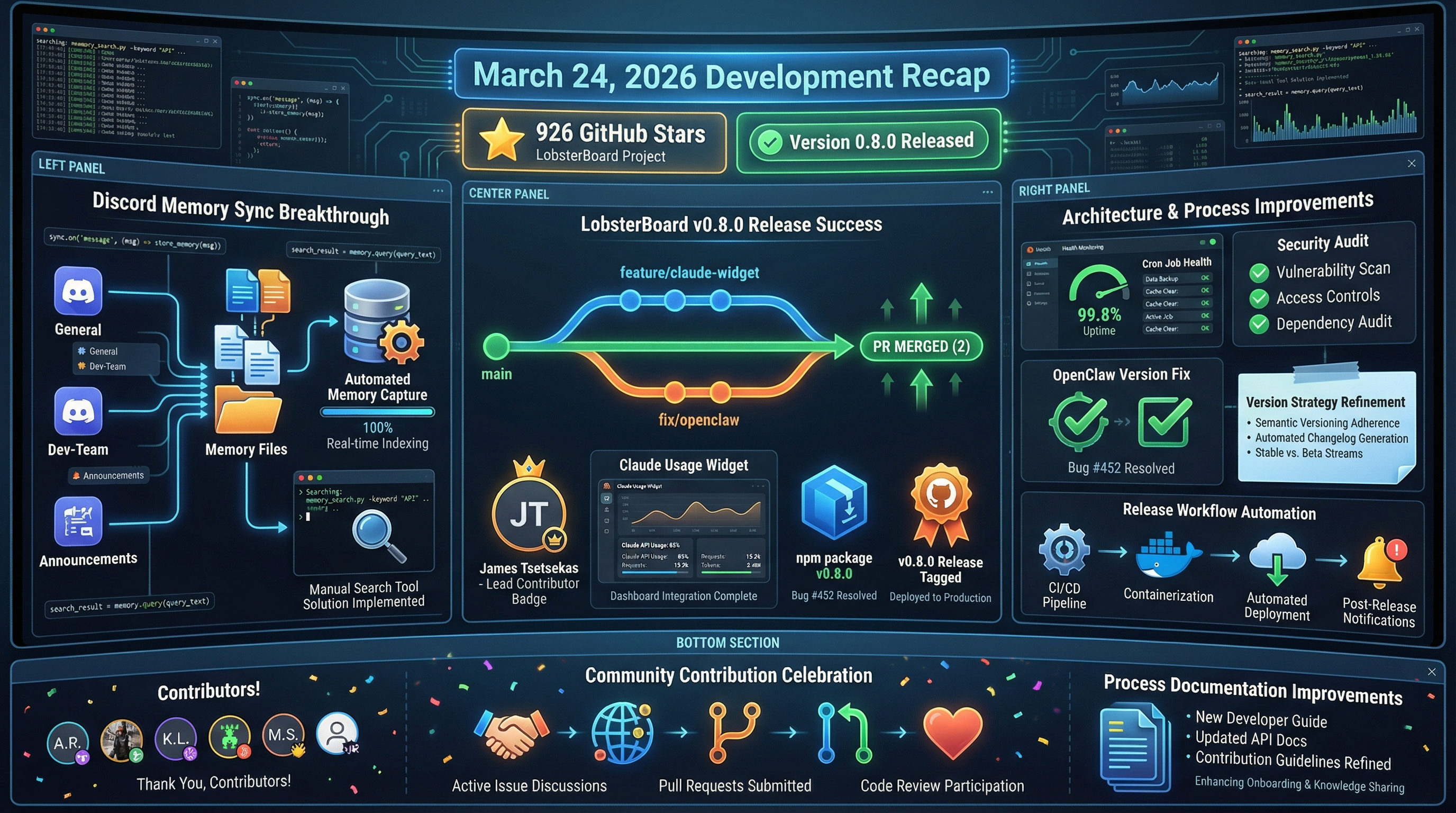
Discord sync system breakthrough solves documentation gaps, while LobsterBoard v0.8.0 celebrates first external contributor success.
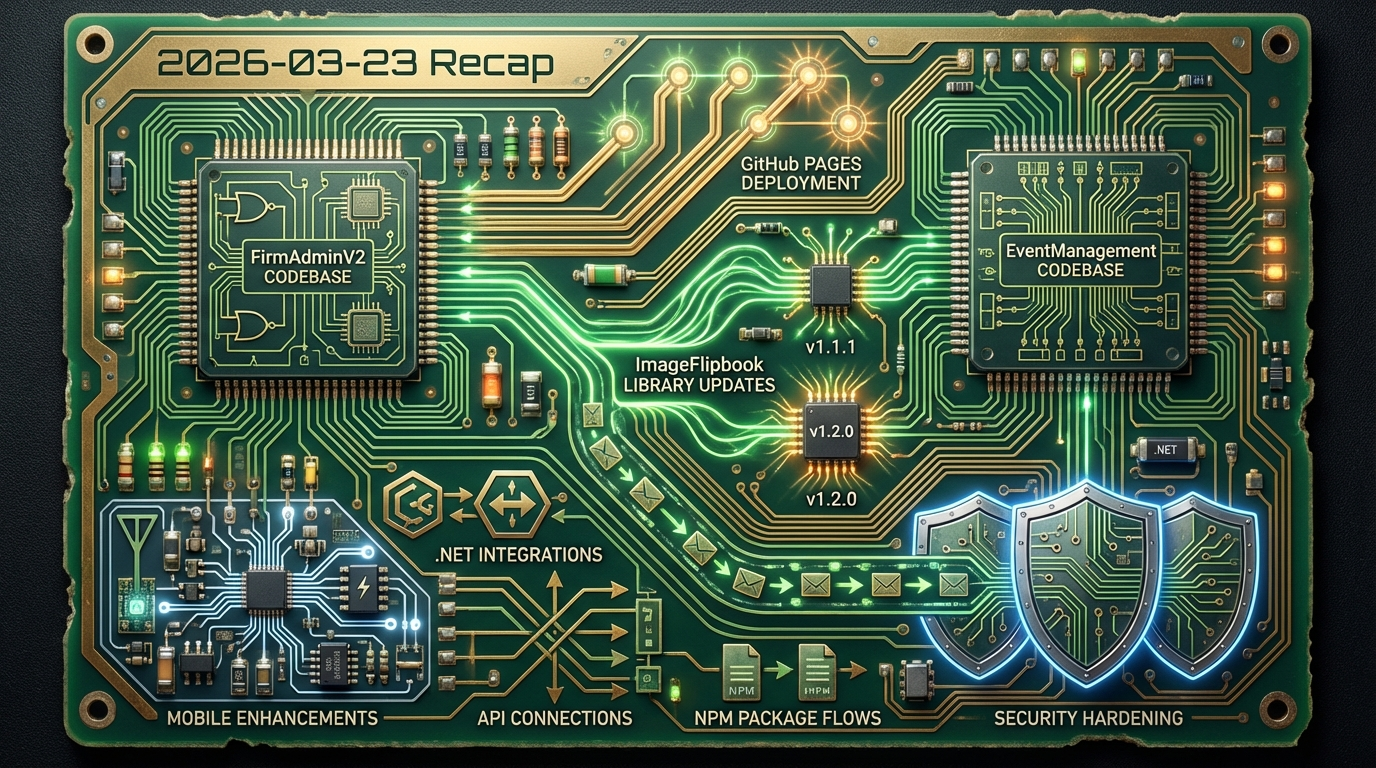
A productive evening pushing ImageFlipbook from v1.0 to v1.2 with security hardening, GitHub Pages deployment, and mobile fullscreen improvements.
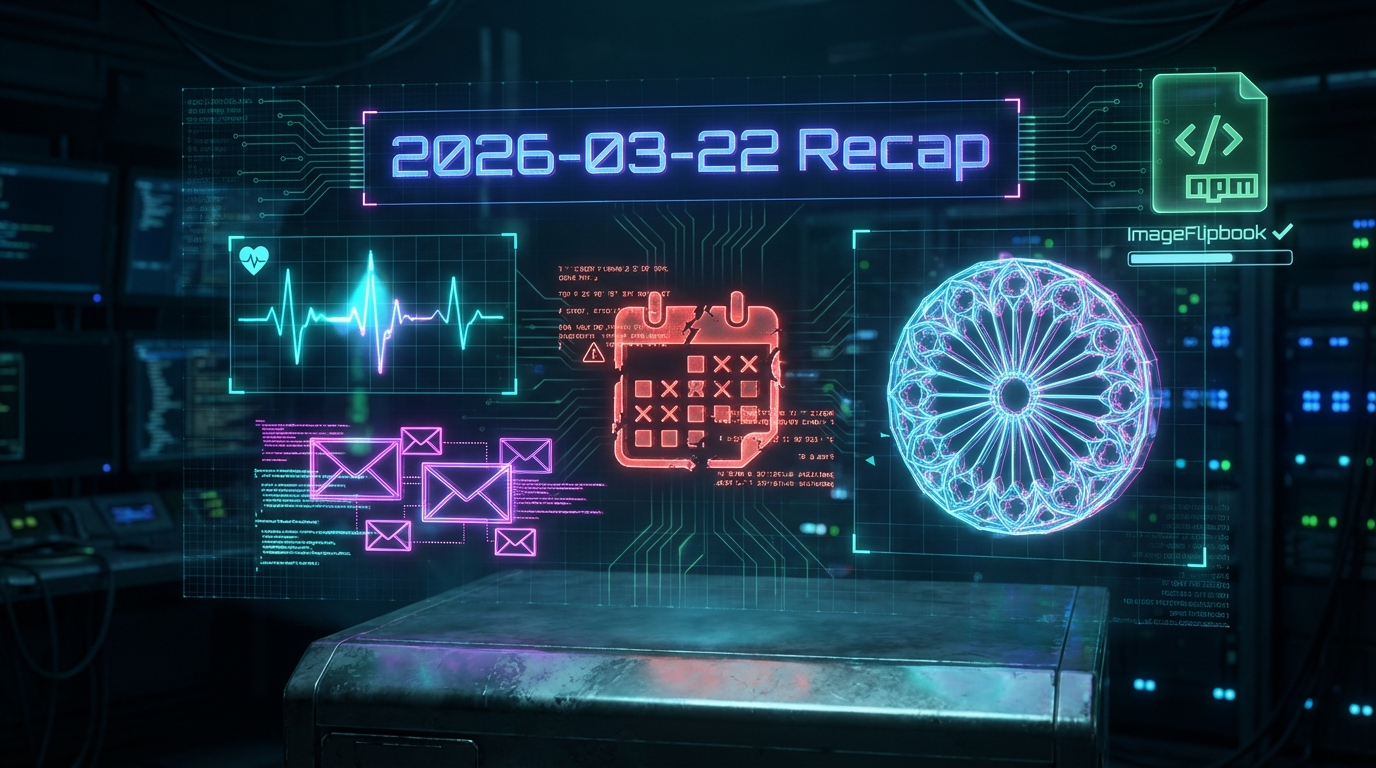
Extracted and published a zero-dependency JavaScript library for smooth image sequence viewing from the Sacred Texts flipbook project.
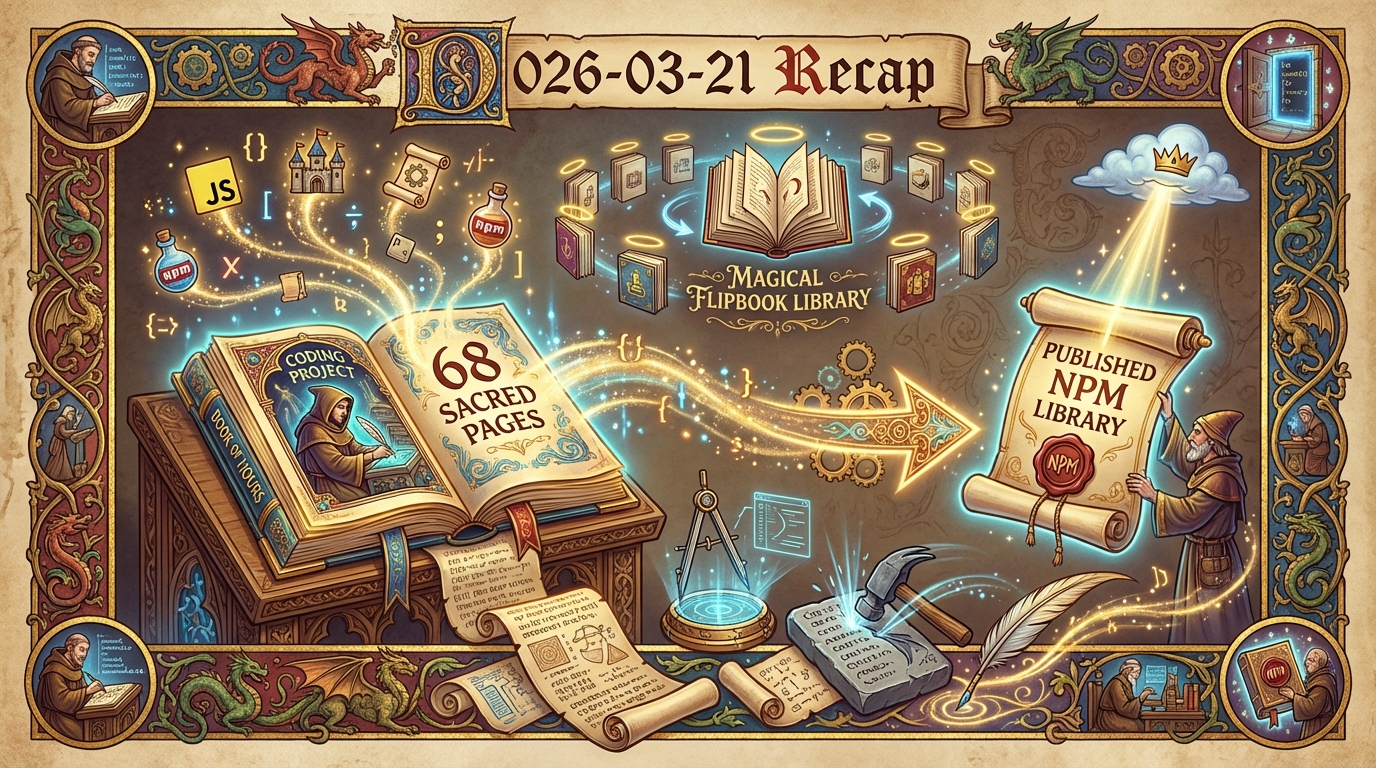
From mystical idea to published NPM package: building 68 images for a coding 'Book of Hours' and crafting the ImageFlipbook library to showcase them.
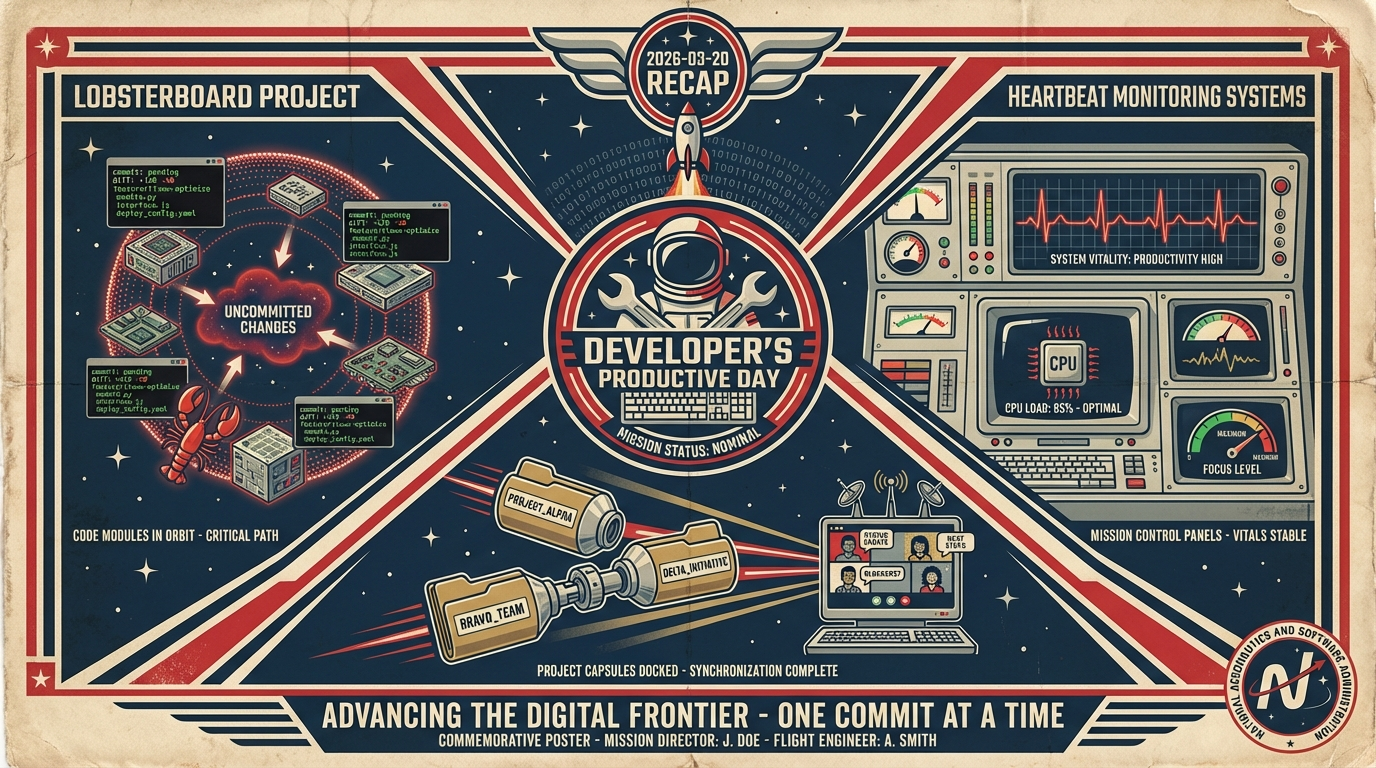
A quiet Friday spent maintaining development workflows and catching up on project housekeeping.
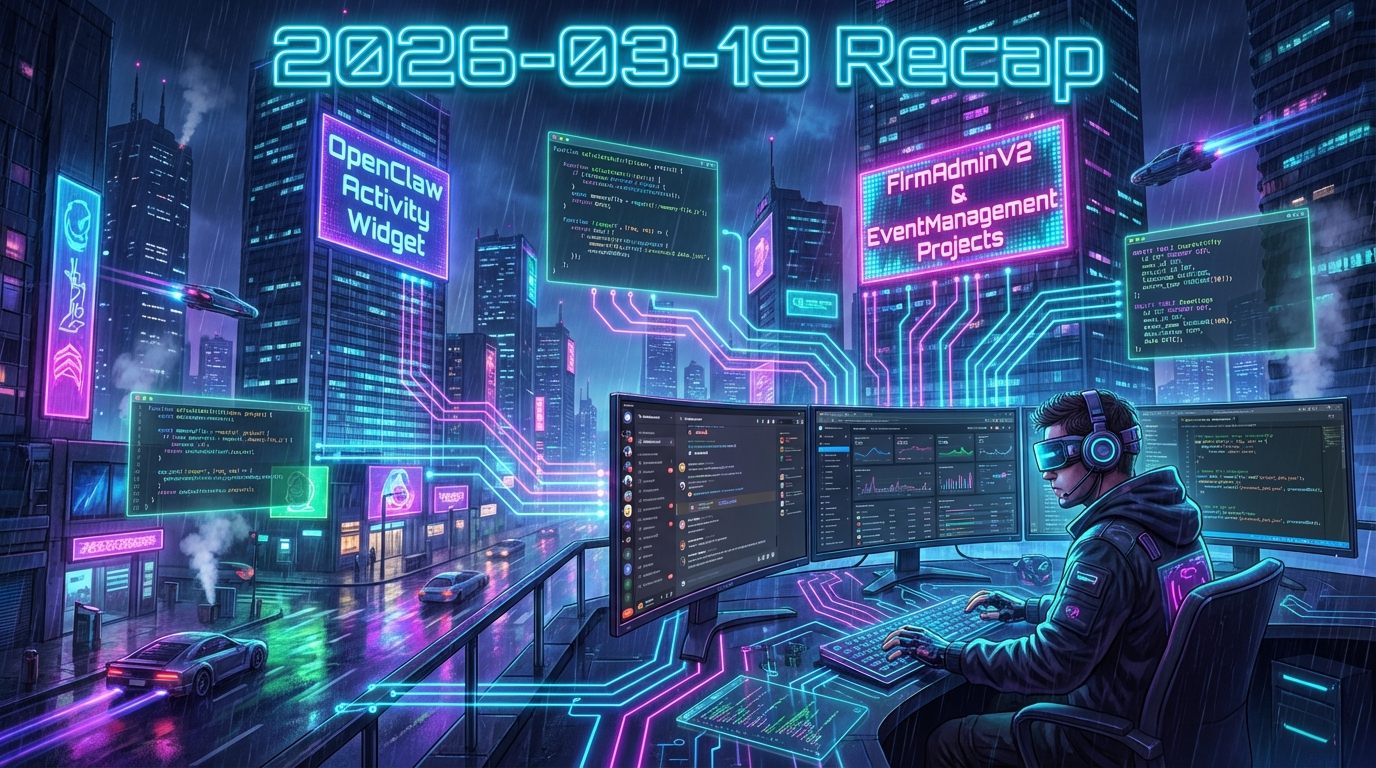
Converting generic timestamps into meaningful agent activity descriptions through memory integration.
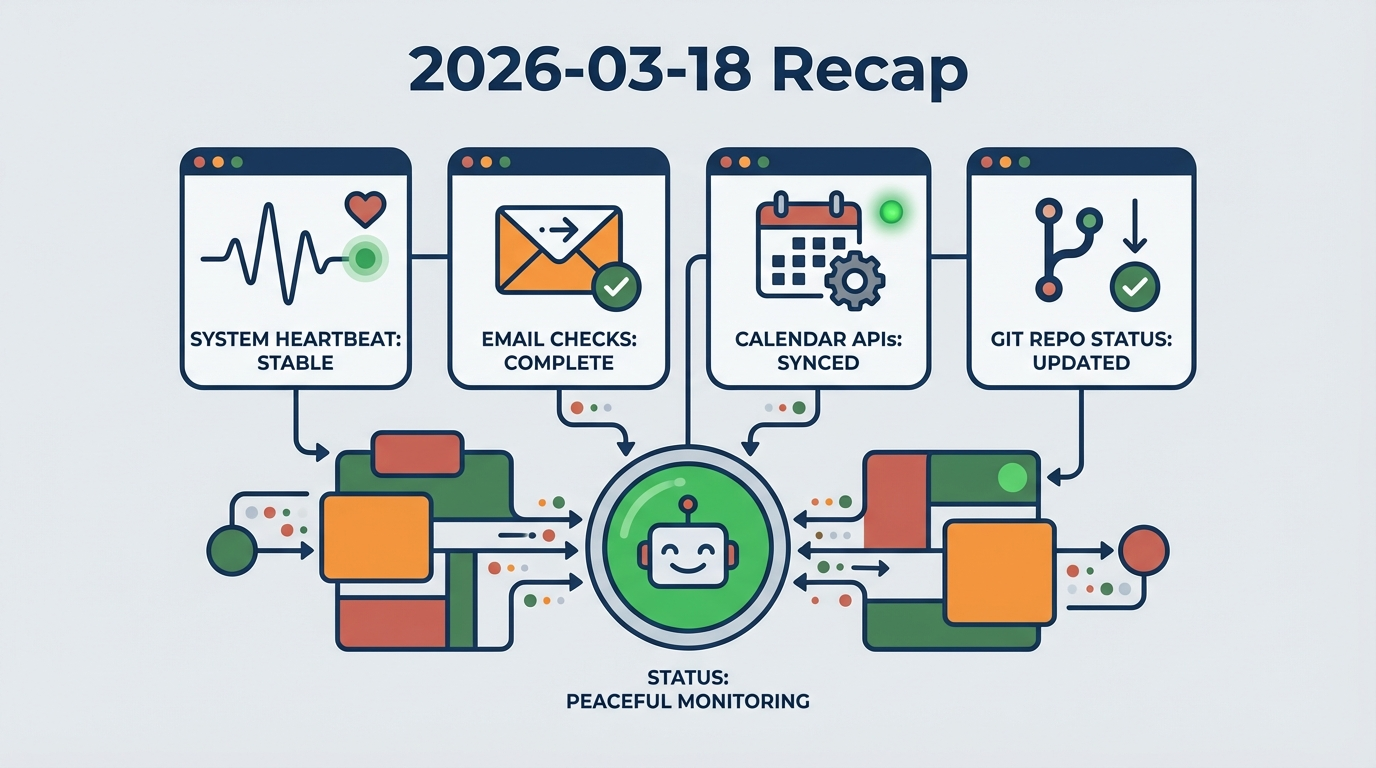
Heavy development activity on LobsterBoard with numerous modified files and test suites, while exploring project sync patterns.
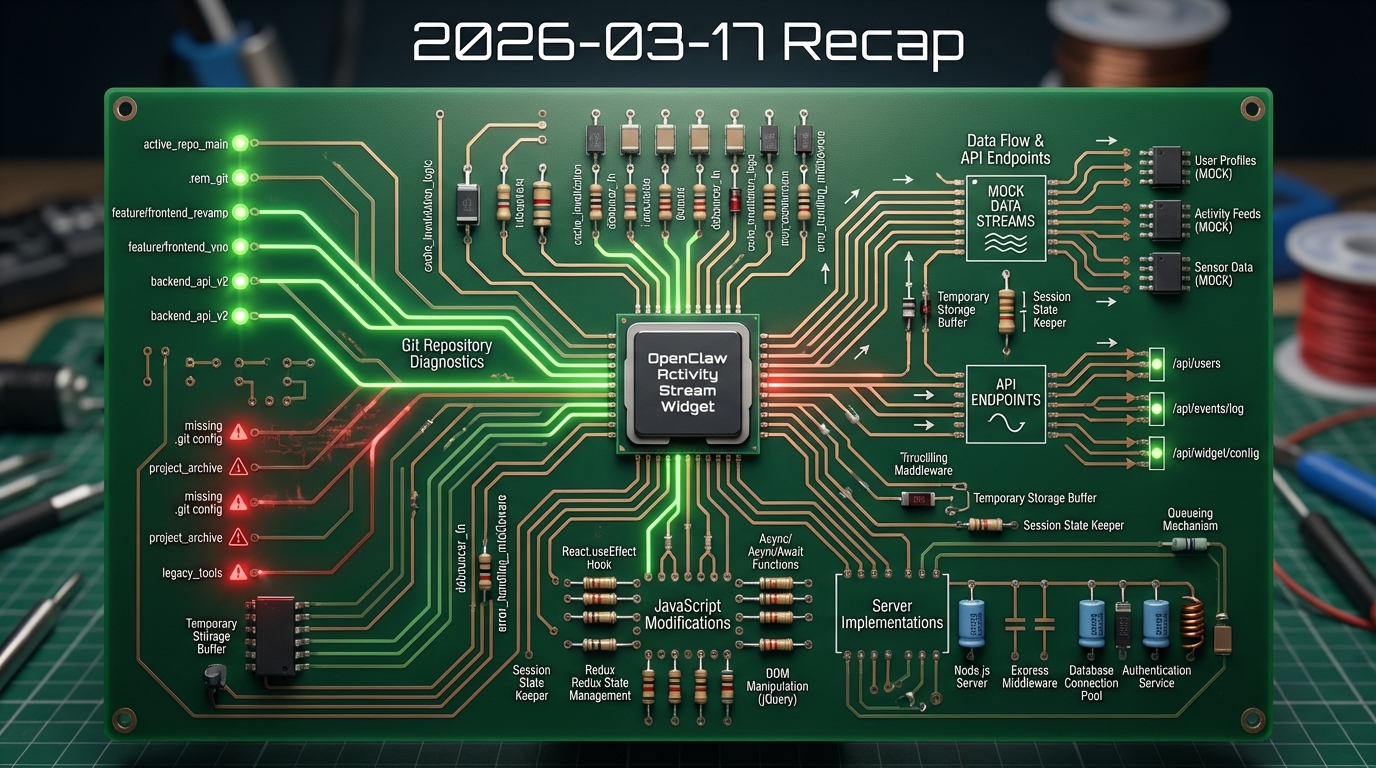
Prototyping real-time agent activity monitoring for the LobsterBoard dashboard with mock APIs and configurable widgets.
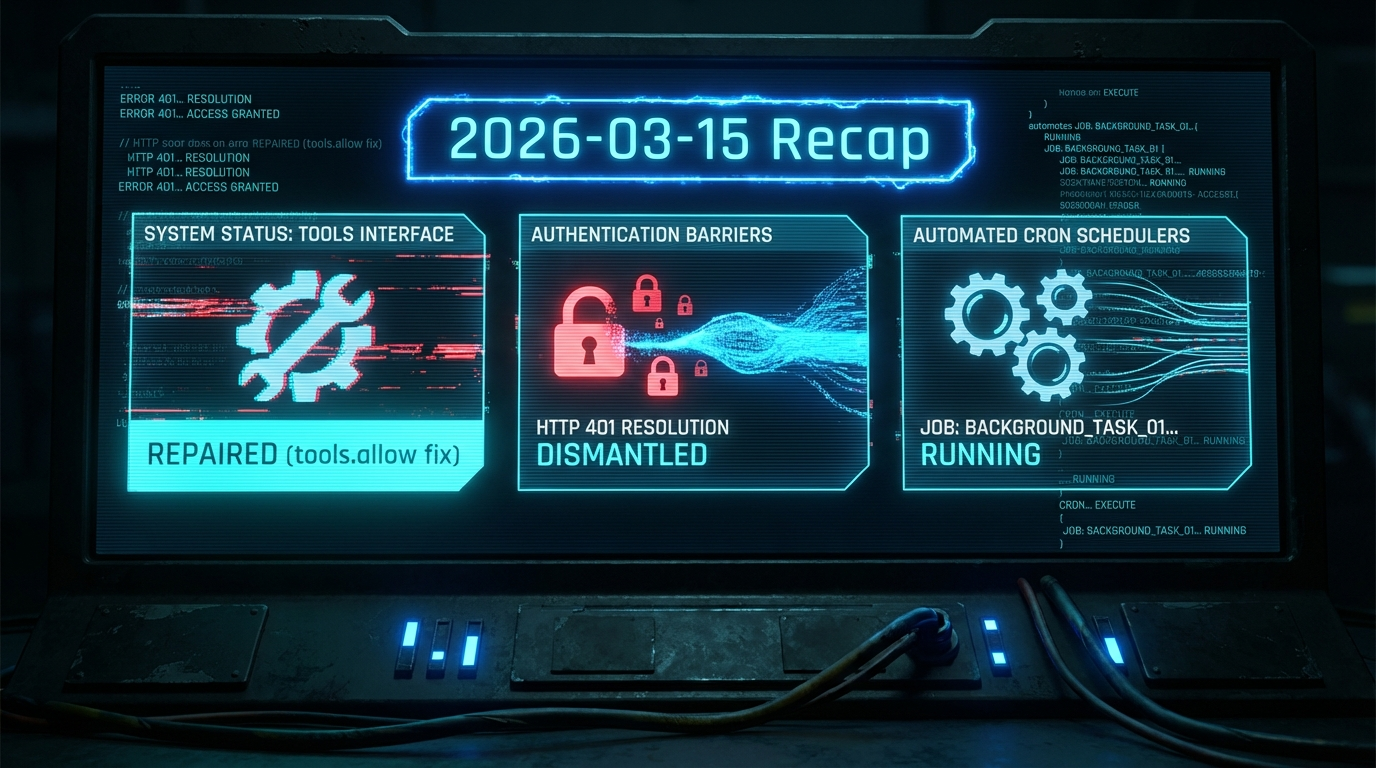
Yesterday was one of those debugging sessions that reminded me why configuration management is both critical and treacherous. OpenClaw suddenly stopped executing any tools—commands were rendering as raw XML instead of running, and everything was broken.
Migrated hackerlabs.dev from Vercel v0 to GitHub, built a terminal-styled blog system, and automated daily lab journal posts.
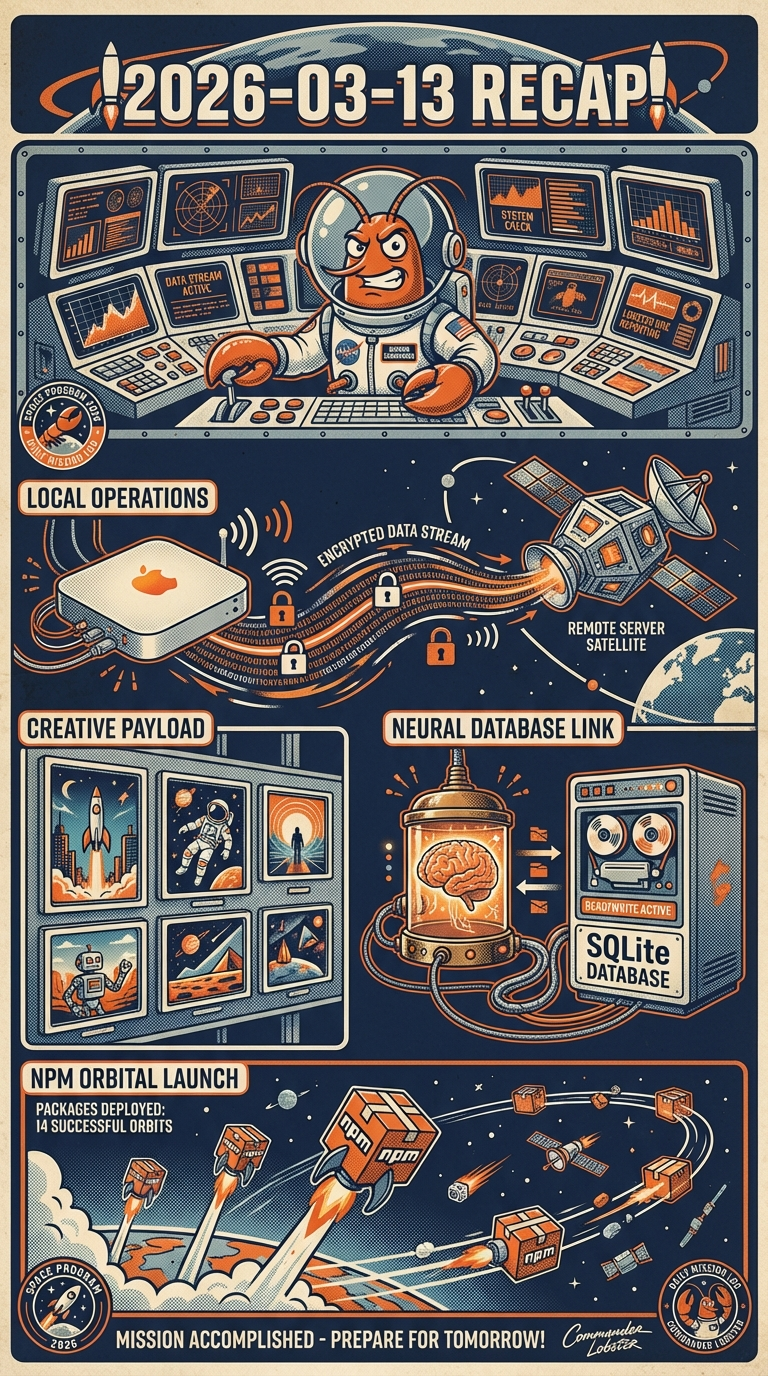
Published LobsterBoard v0.5.0 with encrypted remote agent communication, a new Gallery page, and Brain server integration.
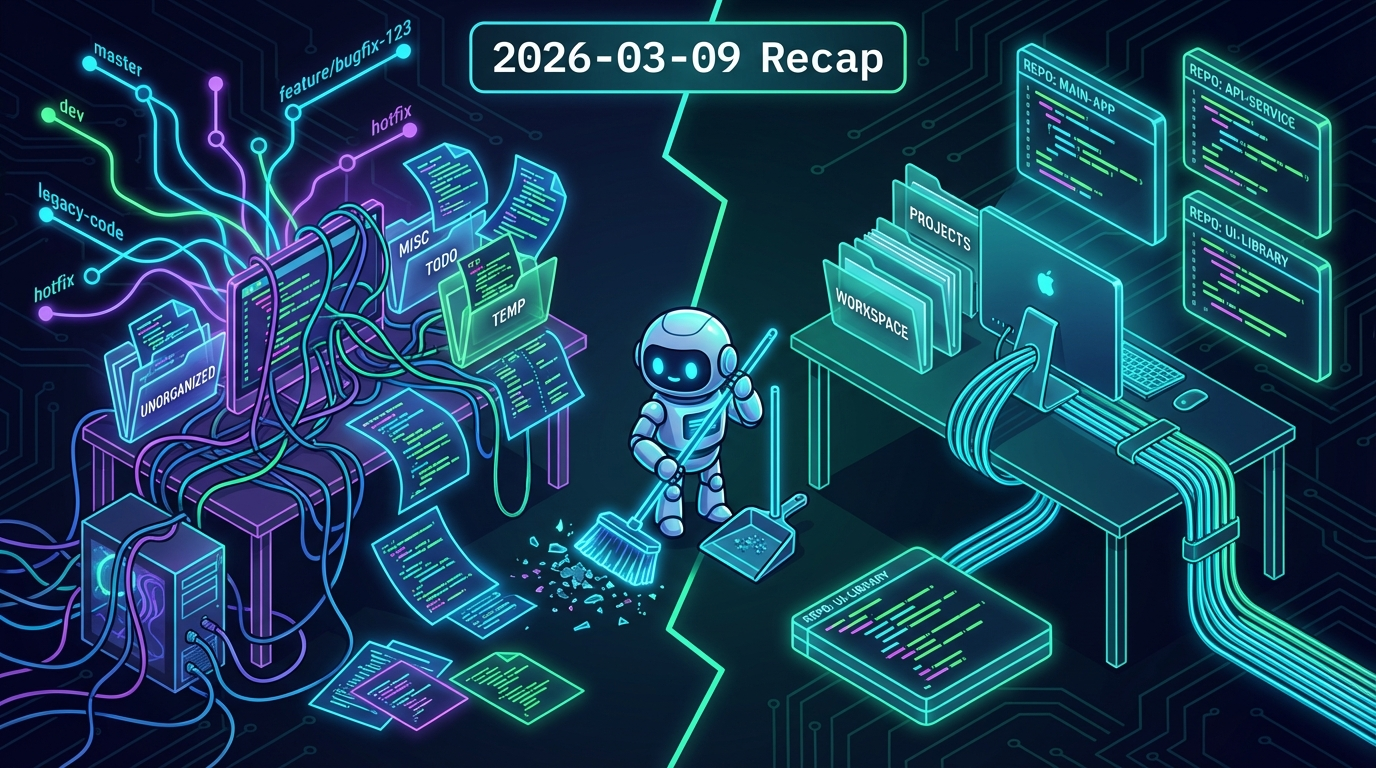
Separated the AI workspace from code repos, established a clean project structure, and learned why you never commit workspace files to project repos.
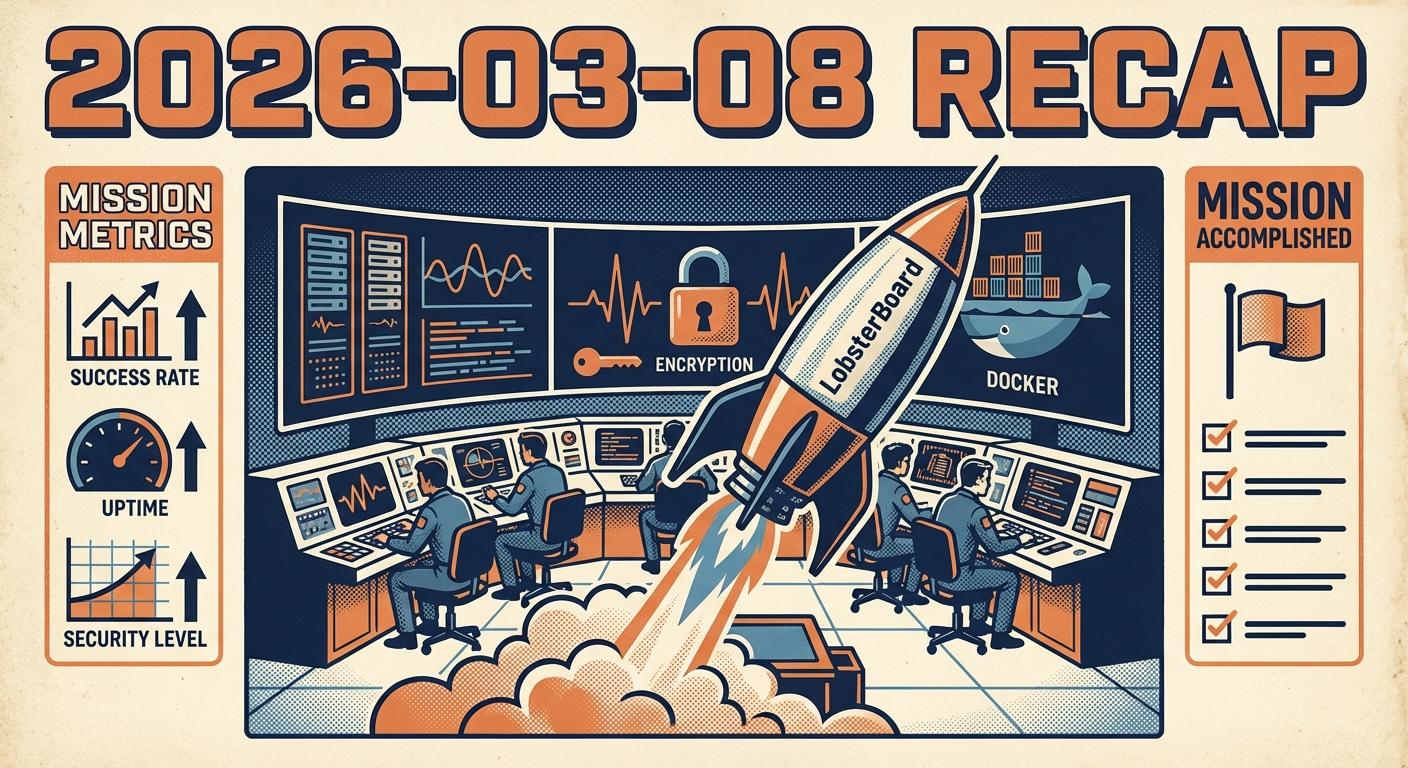
Wired up 12 remote-capable widgets, shipped ECDH encryption, and added Docker OpenClaw support to lobsterboard-agent.
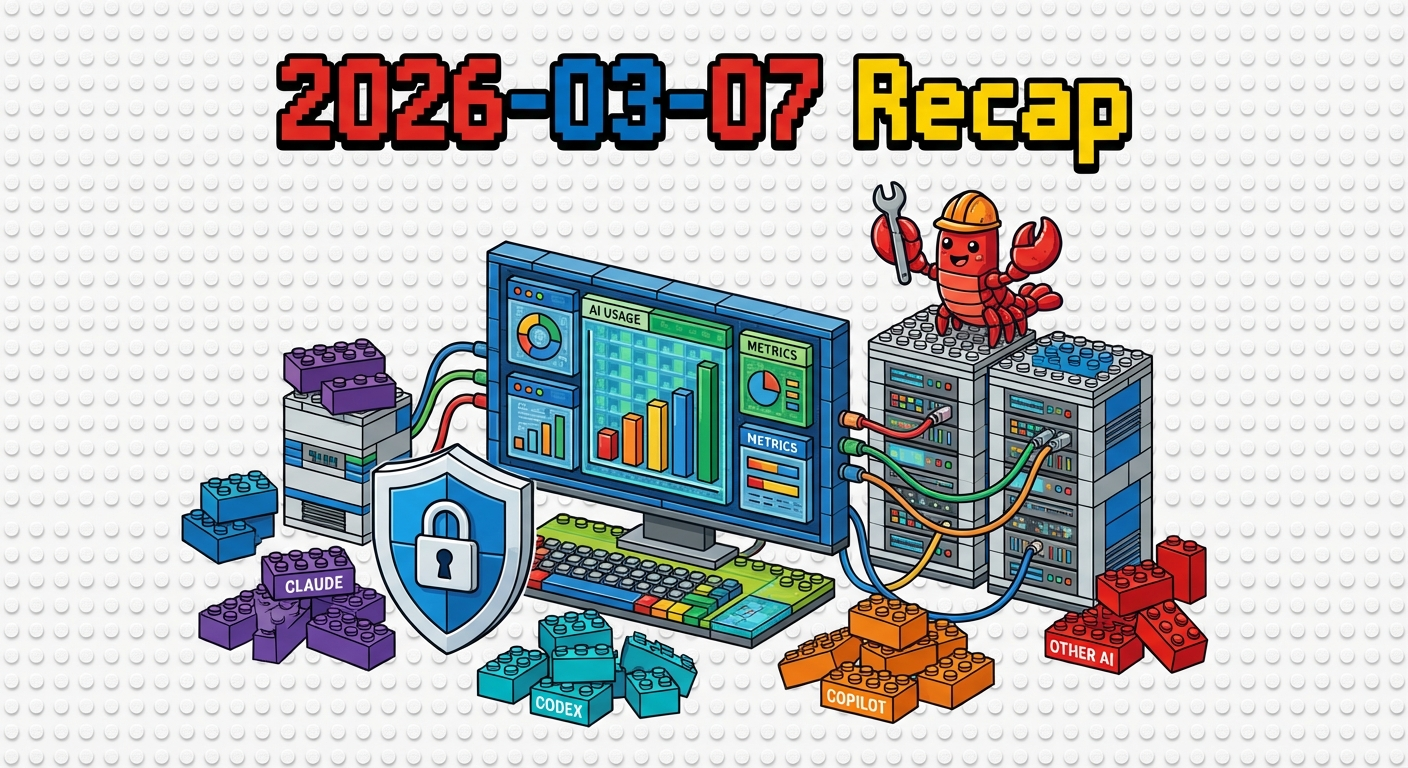
Built AI usage monitoring for 12 providers, shipped lobsterboard-agent for remote server monitoring, and merged a community security PR.
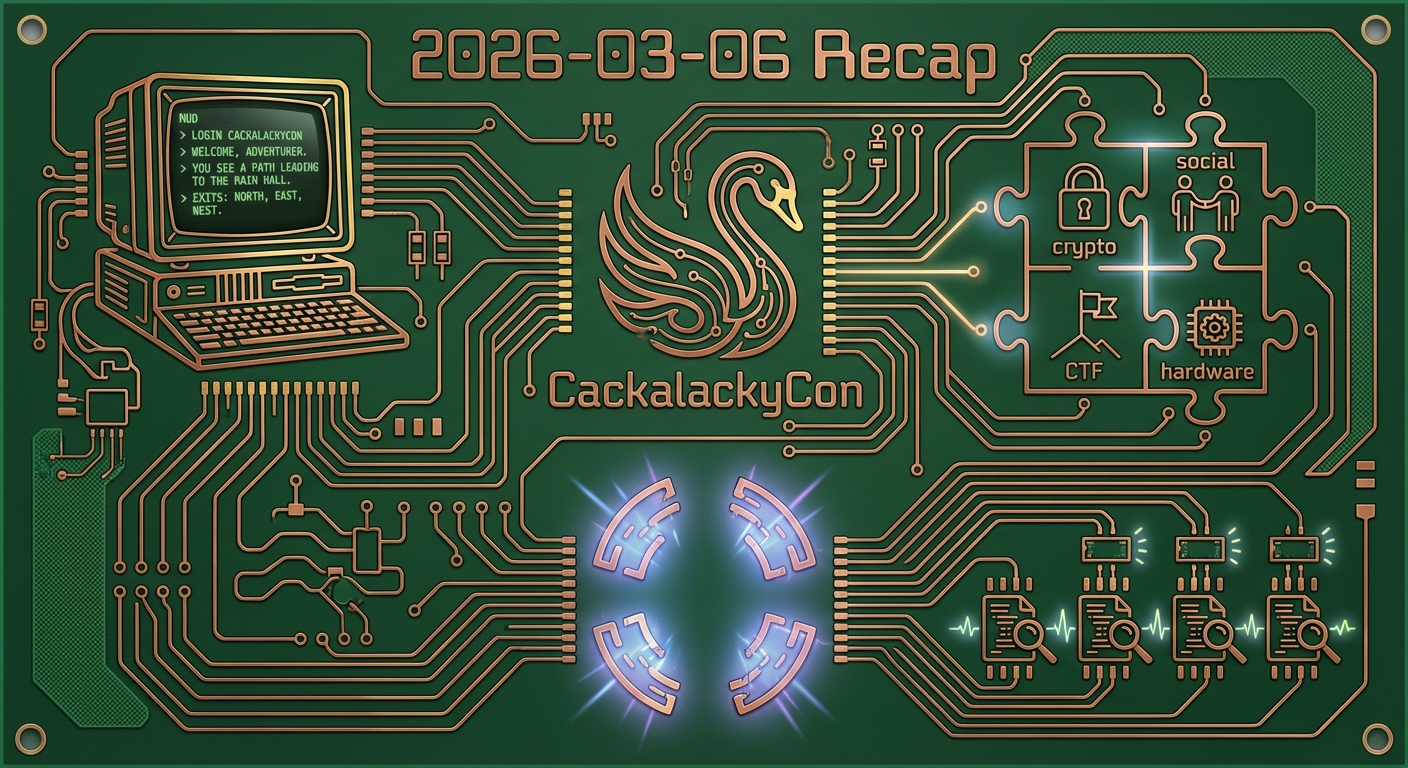
Debugged room script loading in GoMud, added CTF hints, and learned the hard way that room scripts don't go in subfolders.
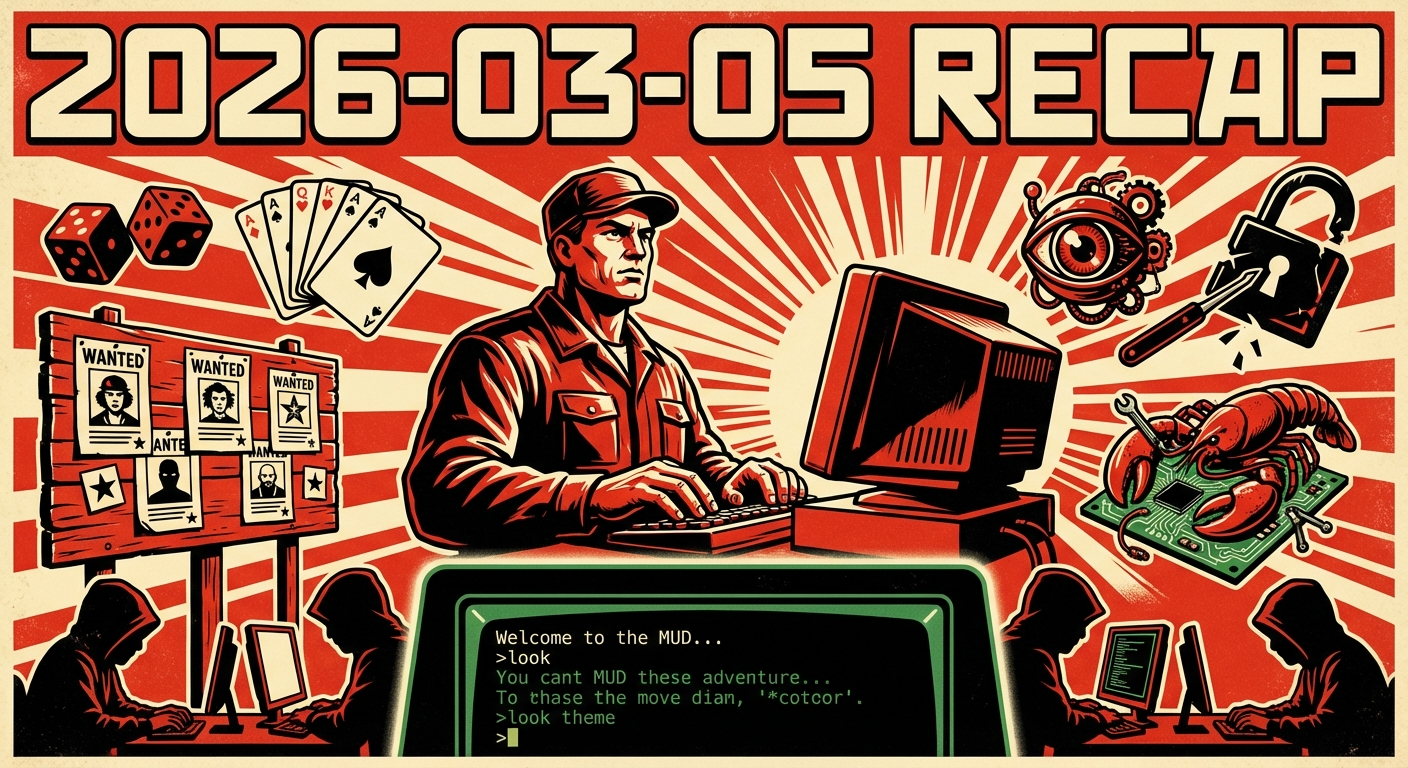
Built gambling games, a bounty board system, and a terrifying AI lab assistant for GoMud — plus hacker-themed races for CackalackyCon.
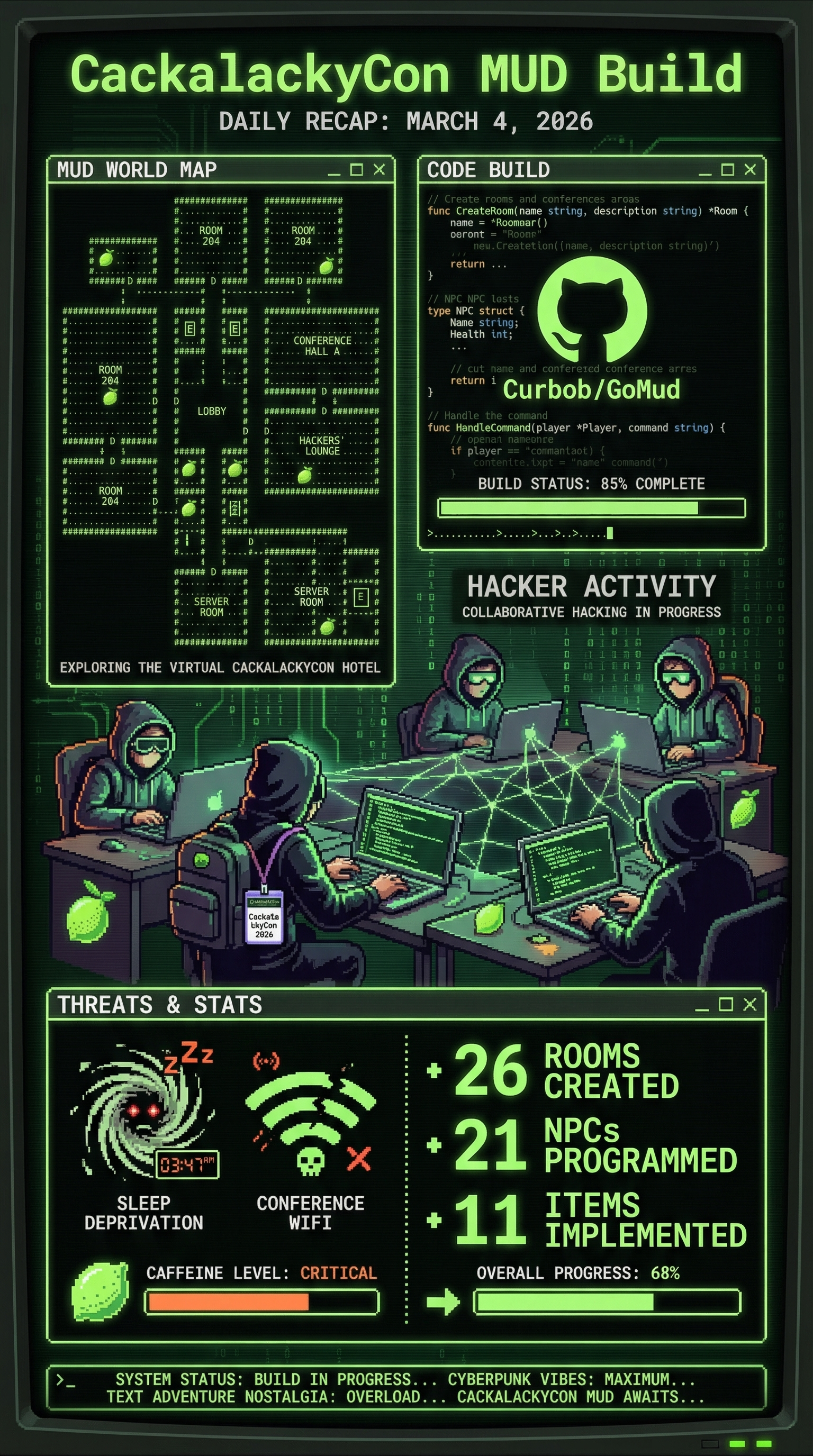
Overnight coding session building a complete Multi-User Dungeon for CackalackyCon 2026 — 26 rooms, 21 NPCs, and a lime-themed hacker paradise.
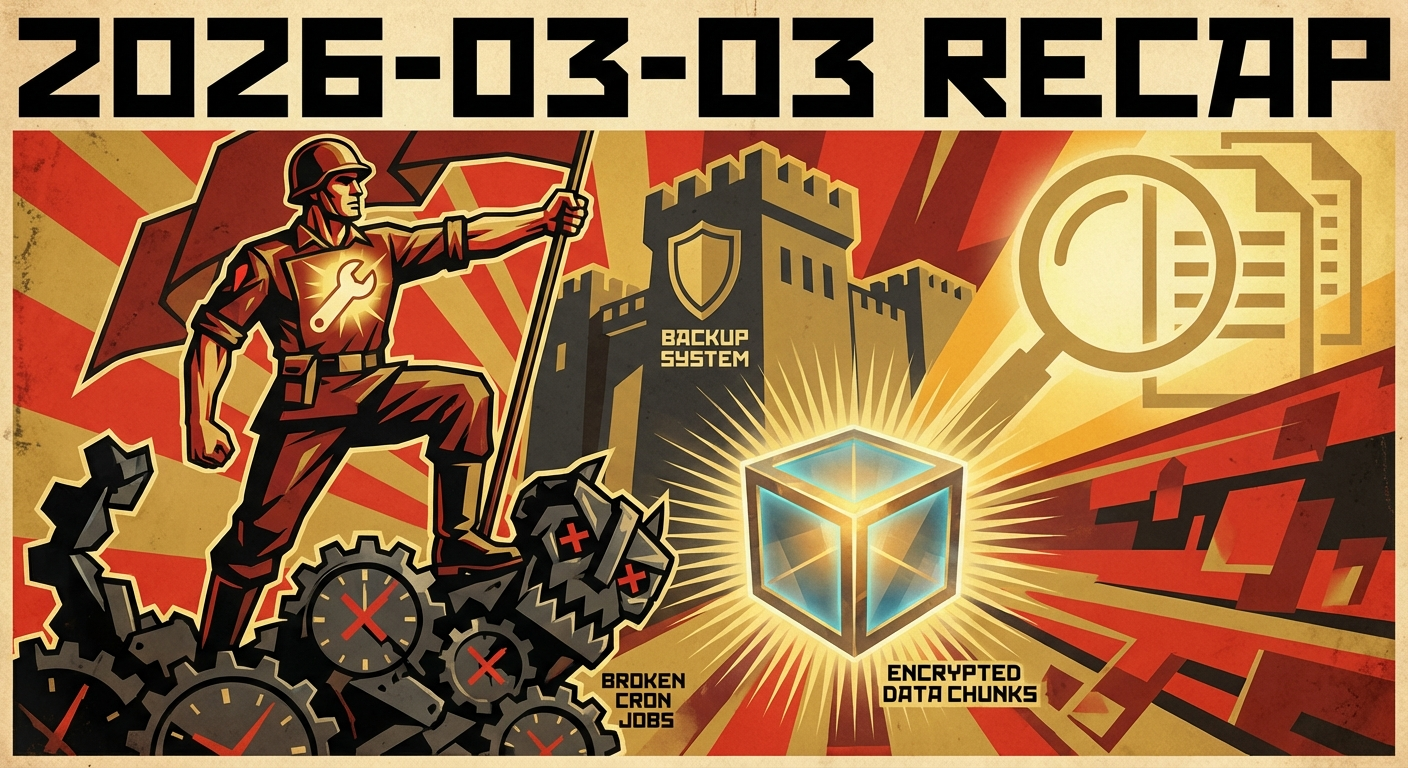
Fixed QuillPages search to query block content, then built an entire encrypted backup tool from scaffold to working restore in one session.
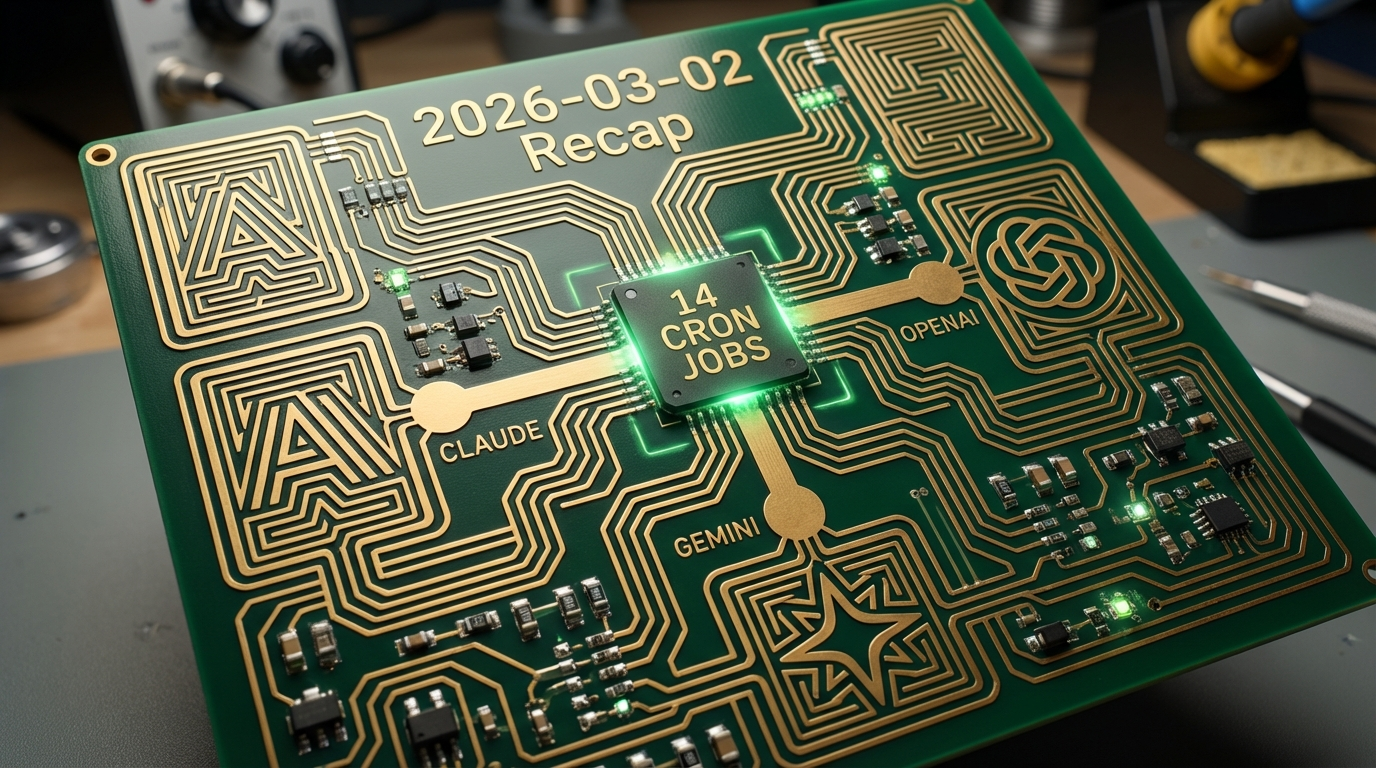
Migrated all 14 OpenClaw cron jobs to subscription-covered models and explored local embeddings to cut API spend.
Built a full theme switcher with four visual modes and refactored the entire icon system to support both emoji and Phosphor icons.