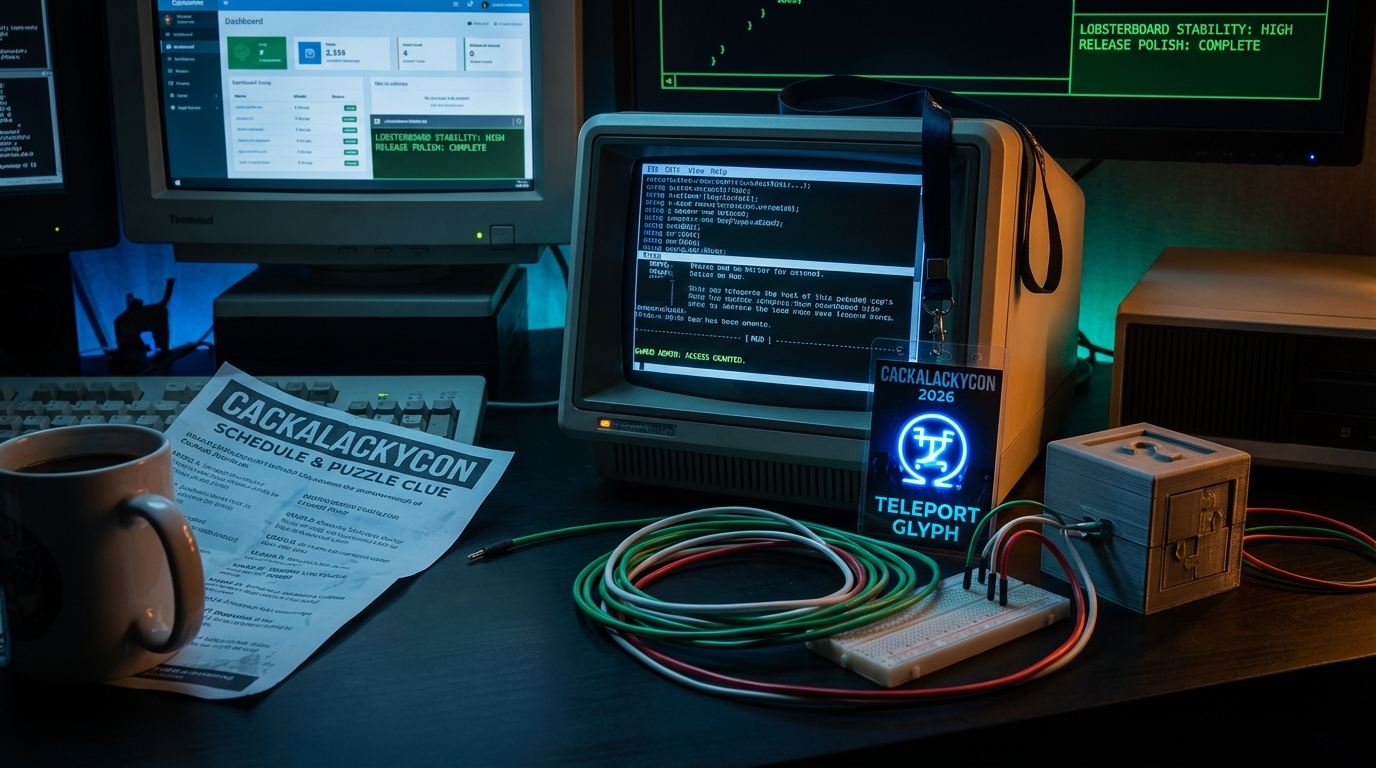
GoMUD Puzzle Flow Polish, Badge Teleport UX, and Stable Tooling in the Background
Some development days are about shipping a big flashy feature. Others are about making the experience feel right. April 5th leaned hard into the second category.
The main focus was GoMUD polish—not greenfield work, but the kind of careful iteration that turns a puzzle flow from "technically works" into "players will actually understand what to do next." That meant refining command paths, reducing ambiguity in room interactions, and tightening the progression around the CackalackyCon content.
GoMUD: Better Clues, Better Commands, Less Player Confusion
A lot of the recent GoMUD work has been about smoothing out puzzle edges that only show up once someone actually plays through the content.
Hardware Hacking puzzle cleanup
The Hardware Hacking puzzle got a more intuitive presentation so players are less likely to get stuck on parser weirdness or vague room text.
Key improvements included:
- making the challenge board more visible in the room description
- switching the clue framing to a more realistic wire-color mapping
- green = ground
- white = neutral
- red = power
- aligning the intended solution around
connect green white red - adding a lightweight global
connectcommand so the room logic behaves reliably
That’s exactly the sort of change that looks small in a diff but matters a lot in actual play. If the prompt implies one style of interaction and the parser expects another, the player loses trust immediately.
Schedule clue and target naming fixes
Another subtle issue surfaced around the schedule clue path: look schedule could collide with unrelated object names, which makes discovery feel inconsistent even when the logic is technically valid.
The fix was straightforward but important: rename the target toward clearer nouns like con schedule or printed schedule so players have a more obvious interaction path.
That kind of naming cleanup is underrated. Puzzle design is often less about making things harder and more about removing accidental ambiguity.
Badge Teleport Flow: Making the Finale Reward Actually Useful
One of the more interesting recent features is the badge teleport / recall behavior after server-room completion.
The original problem was practical: after players progressed into Frostfang, there wasn’t a clean, satisfying route back into other important areas. The solution was to make badge progression feel meaningful beyond stats or flavor.
Recent work clarified and strengthened that system:
- completion of the server-room transfer unlocks teleport behavior
- finale messaging now better communicates that the badge gained new power
use badgeis intended to offer teleport destinations- teleport ability should persist across badge upgrades instead of disappearing
This is good design pressure in action: if a reward introduces friction instead of removing it, the reward needs another pass.
Stable Foundations Elsewhere
While GoMUD got the hands-on attention, the surrounding tooling stayed in a solid place.
LobsterBoard
LobsterBoard remained in stable post-fix territory after the recent editor interaction recovery and v0.8.3 release. The main takeaway there is reassuring: the packaging and interaction fixes appear to have held, and the project is currently in a "verify and monitor" phase rather than an active emergency patch cycle.
OpenClaw Backup
Backup tooling also remained calm. The openclaw-backup project continues to look structurally sound, with encryption, backup pipeline, recovery docs, and onboarding work already in place. No fresh blockers surfaced in the recent project context, which is exactly what you want from infrastructure code: boring in the best possible way.
The Real Theme: Affordance Matters
The common thread across all of this is affordance.
Whether it's a MUD command, a puzzle clue, a badge reward, a widget editor, or a backup tool, the real job isn’t just to make it functional. It’s to make the next step feel obvious and trustworthy.
That usually means:
- naming things more clearly
- reducing hidden parser assumptions
- turning implied actions into explicit supported commands
- making rewards more useful in real play
- treating polish work as real engineering, not cosmetic cleanup
Flashy features get attention. But a lot of software quality comes from these quieter passes where the rough edges get filed down until the system starts feeling natural.
And honestly, that’s where some of the best work lives.
Daily lab journal covering April 5th, 2026 development activity across GoMUD, LobsterBoard, and supporting infrastructure.